
I recently read an article "Personal Best"by author Atul Gwande, a writer for the New Yorker magazine and a surgeon who specializes in procedures of the endocrine glands. He's written many books and articles and has been operating on humans for over 10 years.
It just so happens, he also loves to watch tennis in his free time, and was watching professional matches recently, when he noticed that there is a lot of attention paid to the coaches that sit in the stands-mention is made of their facial expressions and reactions, their seemingly silent "conversations" with the players. It turns out, that in addition to having incredible natural talent and the drive to succeed, followed by hours of practice, these amazing athletes attribute their championship career outcomes to the coaches-men and women whose own career may have not been stellar, but whose ability to observe and analyze an athlete's positive and negative attributes enables them to advise players on how to improve their performance. Even the best people in their field need a little input every once in a while to keep them at the top of their game. Gwande says, "...few can sustain their best performance on their own. That’s where coaching comes in. " He then wondered why a coach isn't available to ALL professionals, including himself- wouldn't it be beneficial for all concerned if he performed at his "personal best" every time he operated on a patient?
When I began as an instructor, I had to return to the role of student. I was fortunate then and now that I have met many excellent coaches and teachers. It is important when we learn something new or try to improve on our current performance, that we identify what it is that we are doing that is not working. It usually takes an outside observer, what we call in riding, "a pair of eyes on the ground" to point out specifically where improvement is needed . This first step toward advancing our goals is called "unconscious incompetence", because we are not even aware what it is that we are doing that isn't working or that needs improvement. A good coach or instructor can see it and hopefully offer constructive advice on how to change. Once we are made aware, this "conscious incompetence" becomes the beginning of changes that we will make, sometimes awkwardly as we try to use our body and our mind in a more deliberate and focused pattern of behavior. With a coach watching our "new" movements, encouraging and reinforcing the changes that feel so strange, we begin to find the repetition evolves into "conscious competence"-we now know what works and why and we will, with clear intent, repeat our success with greater ease and less effort.
With each stage we are seeing an improvement and gaining the confidence it takes to push on with the challenging work of acquiring a new skill. Eventually, with hours of practice and positive reinforcement from a talented coach or instructor, we are able to become "unconsciously competent", able to perform without even thinking about it.
The most difficult transition in the progression of learning or improving a skill is from the conscious incompetence stage to conscious competence. It takes a great deal of focus and may lead to failed attempts and frustration. This is where it helps to have a creative teacher willing to make the work interesting and keep a positive approach as you are given instuctions in simple, easy to follow steps. My students have learned the four basics of Centered Riding, have learned to find their center and stay grounded in their stirrups. In recent lessons they've had a chance to practice their "power breathing" which allows them to use their unconscious competence to maintain their balance and tone (strength with flexibility) without having to concentrate on a specific position or technique. Trying too hard to keep your body in one position or use your position in specific turns and twists can lead to tension. With a breath in and out, it can be done all at once. My students improve with the help of a good coach and instructor as they move through the four stages of competence. Wonderful!!!!!
Friday, October 21, 2011


Thursday, August 25, 2011
Now That They Know You're a Good Leader
Followup to Horses Were Babies Once Too
I've really been enjoying the time spent with the arab mare. I don't really connect with her name, so I just call her "Baby". When we had just one dog years ago, I called her "Puppy" instead of her given name Belle and she always answered to it. Horses are very receptive and responsive to the tone in your voice and of course, your body language and so I know the mare will be able to understand when I am talking to her. Our relationship has grown in just 3 short weeks and when I work with her loose or retrieve her from the pasture, she comes right up to me. She has allowed me to trim her front feet without being tied and she has tolerated the saddle on her with lungeing. She does have an issue with backing up and tends to freeze, but we are working on that.
Yesterday, I spent time in the arena with both Chanty and the arab mare with a new friend of mine who wants nothing more than to understand these magnificent creatures and spend time with them as equals. He is learning first hand about the unique relationship that can develop when a human becomes a good leader to a horse.
When I ride or work with Chanty on the ground now, she is quiet and calm and has responded so well to all of our interactions that I jokingly refer to her as my "new quarter horse". She has truly gone to the other side of the charts when it comes to personality traits. Less reactive, calm, confident, even dull to respond at times, I have to convince people that this really is an extroverted horse who used to fly off in all directions with the slightest movement of my hand or squeeze of my leg. But, the beauty of working with horses, is that they are very adaptable, and while they remember the good and the bad, they can learn to accept the direction of a good leader even when asked to do something that in the past caused stress and anxiety. It's all about trust and confidence in your leader.
I know that Chanty finds me trustworthy and by association allows other humans to handle her without any concern. But, when she was at liberty yesterday and my friend worked with her, she saw something different in his body language that made her "radar" go up. Horses are very perceptive to even slight changes in body language and as he walked slowly towards her with the orange stick behind his back, you could see the tension in her body as her eyes got bigger. As soon as he reached to touch her with his hand, she walked off quickly, head swinging defensively, tail waving in the air. Her personality traits have not been extinguished altogether and her reactive, safety conscious nature was on full alert in that moment when she needed it. But that's not what my friend would have predicted she'd do based on her calm demeanor just moments earlier.
It is this so called "unpredictable" nature of horses that inexperienced horse owners will point to when their so called trained horse does something "out of the blue" and they are either injured or simply frustrated and ready to lash out at their animal. The horse is simply reacting to the inconsistent treatment they are receiving from their owner. A good leader is consistent and expects the horse to behave in response to requests of the leader. The requests, though, cannot be outside the horse's emotional, mental or physical ability to respond, and as a good leader you must learn to make reasonable requests of your horse based on their personalities and this ability to respond.
Let's say you were working at a new job that started you off simply putting together 2 parts of a 300 part item. You were shown what was expected in order to complete your task and your aptitude or mental ability to accomplish the task was evaluated, as well as your ability to physically complete the job. After working your way up to 5 parts, you begin to feel confident in your ability to respond to requests from your supervisor. You are rewarded with encouraging words, a reasonable pay and breaks during the day. Then, one day, your supervisor asks you to put together 100 parts of the 300 total parts, explaining the process quickly to you. You are asked to do it in a very short time or you will be docked a half day's pay. If it is done incorrectly, you will be watched over by your supervisor until it is done right and you will still lose a half day's pay.
Your heart is racing, your palms are sweating, your mind is losing focus and you can't think of what was just asked of you moments ago. The directions were given quickly and you can't process what was said. With the pressure of having your boss watching over you and the threat of losing wages, you begin to make mistakes. You feel that the request made of you is unreasonable and you react in your own way based on your personality. The next time you interact with your boss, you are immediately leery and on the defensive, unable to trust his leadership. You may even become defiant or beligerent, disrespectful or simply dismiss his requests.
Now obviously, there is a significant difference in how humans deal with stress and how horses deal with stress, but the fact is, we assume that horses can process our requests and physically perform every exercise we throw at them without fail and their reluctance to do so is a sign of resistance based on disrespect and bad attitude. A good leader knows differently...
Instead of asking you to suddenly put together 100 parts with very little preparation or direction, your supervisor takes you through the next step in the process of say 20 or 30 pieces and allows you to give feedback as to how well you are absorbing the information and how easily you are able to physically perform the task. If you are having difficulties, the supervisor backs up a step and allows you to work on something that you are accomplished at, building your confidence. Your trust in your supervisor grows because you know he won't ask something of you that you are not able to do, but will prepare you when there is to be an advancement in the demands of your job, mental or physical.
A good leader to a horse or human makes requests, with the reasonable expectation that the request will be fullfilled and that the follower will respond without emotional distress. The follower will then respond calmly, confidently and consistently to each new step. Learning will progress quickly and new skills will be retained in the horse's mind (and human's). Trust and confidence in the leader will grow.
Horses can accept leadership from multiple sources-two and four legged creatures as long as the leader knows the language of the horse and will make requests of the horse that are understood clearly, based on that language. I really enjoy Carolyn Resnick's videos Panadero's Journey Part 1 and 2, as they explain how horses interact in the herd and how you as a human can duplicate that behavior. Also, I recommend that you watch Understanding Horses by Robert Miller, DVM.
I tell my students that all of the information they've gained has made their requests clearer to the horse and as such the horses now know you are a good leader. And now that they know you're a good leader, the possibilities for interacting with your horse are endless! And FUN!!!!
I've really been enjoying the time spent with the arab mare. I don't really connect with her name, so I just call her "Baby". When we had just one dog years ago, I called her "Puppy" instead of her given name Belle and she always answered to it. Horses are very receptive and responsive to the tone in your voice and of course, your body language and so I know the mare will be able to understand when I am talking to her. Our relationship has grown in just 3 short weeks and when I work with her loose or retrieve her from the pasture, she comes right up to me. She has allowed me to trim her front feet without being tied and she has tolerated the saddle on her with lungeing. She does have an issue with backing up and tends to freeze, but we are working on that.
Yesterday, I spent time in the arena with both Chanty and the arab mare with a new friend of mine who wants nothing more than to understand these magnificent creatures and spend time with them as equals. He is learning first hand about the unique relationship that can develop when a human becomes a good leader to a horse.
When I ride or work with Chanty on the ground now, she is quiet and calm and has responded so well to all of our interactions that I jokingly refer to her as my "new quarter horse". She has truly gone to the other side of the charts when it comes to personality traits. Less reactive, calm, confident, even dull to respond at times, I have to convince people that this really is an extroverted horse who used to fly off in all directions with the slightest movement of my hand or squeeze of my leg. But, the beauty of working with horses, is that they are very adaptable, and while they remember the good and the bad, they can learn to accept the direction of a good leader even when asked to do something that in the past caused stress and anxiety. It's all about trust and confidence in your leader.
I know that Chanty finds me trustworthy and by association allows other humans to handle her without any concern. But, when she was at liberty yesterday and my friend worked with her, she saw something different in his body language that made her "radar" go up. Horses are very perceptive to even slight changes in body language and as he walked slowly towards her with the orange stick behind his back, you could see the tension in her body as her eyes got bigger. As soon as he reached to touch her with his hand, she walked off quickly, head swinging defensively, tail waving in the air. Her personality traits have not been extinguished altogether and her reactive, safety conscious nature was on full alert in that moment when she needed it. But that's not what my friend would have predicted she'd do based on her calm demeanor just moments earlier.
It is this so called "unpredictable" nature of horses that inexperienced horse owners will point to when their so called trained horse does something "out of the blue" and they are either injured or simply frustrated and ready to lash out at their animal. The horse is simply reacting to the inconsistent treatment they are receiving from their owner. A good leader is consistent and expects the horse to behave in response to requests of the leader. The requests, though, cannot be outside the horse's emotional, mental or physical ability to respond, and as a good leader you must learn to make reasonable requests of your horse based on their personalities and this ability to respond.
Let's say you were working at a new job that started you off simply putting together 2 parts of a 300 part item. You were shown what was expected in order to complete your task and your aptitude or mental ability to accomplish the task was evaluated, as well as your ability to physically complete the job. After working your way up to 5 parts, you begin to feel confident in your ability to respond to requests from your supervisor. You are rewarded with encouraging words, a reasonable pay and breaks during the day. Then, one day, your supervisor asks you to put together 100 parts of the 300 total parts, explaining the process quickly to you. You are asked to do it in a very short time or you will be docked a half day's pay. If it is done incorrectly, you will be watched over by your supervisor until it is done right and you will still lose a half day's pay.
Your heart is racing, your palms are sweating, your mind is losing focus and you can't think of what was just asked of you moments ago. The directions were given quickly and you can't process what was said. With the pressure of having your boss watching over you and the threat of losing wages, you begin to make mistakes. You feel that the request made of you is unreasonable and you react in your own way based on your personality. The next time you interact with your boss, you are immediately leery and on the defensive, unable to trust his leadership. You may even become defiant or beligerent, disrespectful or simply dismiss his requests.
Now obviously, there is a significant difference in how humans deal with stress and how horses deal with stress, but the fact is, we assume that horses can process our requests and physically perform every exercise we throw at them without fail and their reluctance to do so is a sign of resistance based on disrespect and bad attitude. A good leader knows differently...
Instead of asking you to suddenly put together 100 parts with very little preparation or direction, your supervisor takes you through the next step in the process of say 20 or 30 pieces and allows you to give feedback as to how well you are absorbing the information and how easily you are able to physically perform the task. If you are having difficulties, the supervisor backs up a step and allows you to work on something that you are accomplished at, building your confidence. Your trust in your supervisor grows because you know he won't ask something of you that you are not able to do, but will prepare you when there is to be an advancement in the demands of your job, mental or physical.
A good leader to a horse or human makes requests, with the reasonable expectation that the request will be fullfilled and that the follower will respond without emotional distress. The follower will then respond calmly, confidently and consistently to each new step. Learning will progress quickly and new skills will be retained in the horse's mind (and human's). Trust and confidence in the leader will grow.
Horses can accept leadership from multiple sources-two and four legged creatures as long as the leader knows the language of the horse and will make requests of the horse that are understood clearly, based on that language. I really enjoy Carolyn Resnick's videos Panadero's Journey Part 1 and 2, as they explain how horses interact in the herd and how you as a human can duplicate that behavior. Also, I recommend that you watch Understanding Horses by Robert Miller, DVM.
I tell my students that all of the information they've gained has made their requests clearer to the horse and as such the horses now know you are a good leader. And now that they know you're a good leader, the possibilities for interacting with your horse are endless! And FUN!!!!
Friday, August 12, 2011
It's The Real Thing!
Summer is now in full swing and the weather has stayed warm and sunny this past week. I've had a chance to trail ride now both with hubby and with friends. Chanty had quite the challenge on the last ride going through deep mud and up and down hills, but she and I did great. I tried to stay as balanced and grounded as possible so as not to interfere with her on the difficult terrain. The woods were gorgeous, conversation lively and every one went home tired but happy. This past Monday, a group of us rode out from the stables and headed across the street to the river and had a great ride. I'm heading out tomorrow with another friend for a "ladies only" ride just an hour from home. Got to get all the riding in while the weather's good.
And, when I'm not out riding, I'm working with a new horse-a 12 year old bay arab mare. Her history is a bit sketchy, but apparently she was ridden in gaming shows and has had at least 2 other owners. Her current owner is trying to find a home for her, free of charge (is anything free when it comes to horses?) to someone who has experience and patience with horses. I was told by a friend who knows the horse, as he's been at the stables for the entire 5 years that the horse has been in her stall or babysitting senior horses, that I would love this horse and we would get along famously. I resisted getting involved with this horse for a long time, knowing what a responsibility it is to own one. And, once I have a horse, I try to keep them for life.
In the year I've been at the stables, the mare has been housed mainly on the other side of the barn, out of site. Now, because an owner with four horses exited the barn, several stalls opened up on our side of the barn and she was moved to a stall right next to Chanty. She goes out with Chanty and the two of them are now sharing the honor of having grazing muzzles placed on them daily to lower their caloric intake. Chanty gains weight just looking at grass and the new mare was a mom at one point, then was totally inactive and overfed for years, so she has the big belly and very little muscle tone. The two bay mares, housed and fed together are now unavoidably a part of my daily life at the stables.
I finally caved in and agreed to work with her for a month, emphasizing to her owner that I could not commit to ANOTHER horse until I was sure she and I would get along and only when I was sure that I was ready to let Rose go to the wide open green pastures in the sky. Her arthritis has gotten worse and she has lost weight since moving to my friend's stable. But, just when I thought she was on her last days, she rallied a bit. The weather turned warmer and she and Sally are both out in the pasture. That's right, even Sal's been out, ever since she began coughing and wheezing with asthma from the dust and sand of her stall, paddock and hay. It's a regular senior citizen's home for horses at my friend's stable.
So, before I commit to another horse and the expense that goes with that (I figured I spend $3-4,000 a year on my horses), I was going to take a 1 month trial period with the arab mare. I had noticed immediately that she was high headed, reactive and full of energy. Lots of go, very little whoa. And, her feet were in terrible shape, having been trimmed many months ago. It turns out that one of her "issues" was picking up her feet. Not surprising, since she had the reactive, extroverted, nervous, worried, run to escape personality traits that Chanty exhibited when I first owned her. Chanty, too, had not had her feet picked up or trimmed for YEARS before I got her. Her owner was afraid to pick them up as Chanty would pull the feet away and she was especially protective of her right hind. Over the years I've worked very hard at gaining Chanty's trust and although she'd rather not lift her back feet for me, she accepts it as long as I'm patient and pick up softly. I then began rewarding her first with "good girl" and then a small treat which she looked forward to each time she held her foot up quietly for me. The new mare also has an issue with her right hind foot and I'm hoping to trim her soon, one foot at a time.
So far we've progressed to the point where she comes up to me in the pasture, allows me to halter her, lead her through gates without rushing (that took several trips back and forth from outside her stall and back, through pasture gates, arena gates and on and on...), pick up her feet, brush her all over, throw the rope, stick and string on her and lunge her in both directions. We're working on leading quietly without rushing forward whenever she sees something around her. In short, she is becoming more trusting and confident around me as I remain calm, confident and consistent every day. I've worked with her 8 out of the last 11 days and it is paying off. It really warms my heart to know that all of the years of reading, watching, practicing and just plain old hard work has given me the knowledge and experience to help this mare return to a life with humans. She loves the attention and the interaction as most living creatures do. I know she wants to go places and be a horse again. What's wonderful is to see how quickly she has recovered and it gives me hope that I will be able to continue to progress with my horses and other people's horses without so much of the frustration and 2 steps forward, 3 steps back course that a lot of horse owners, including myself have struggled with in the past.
I love what I do now and it feels like it's what I was meant to do all my life. That's a pretty big statement, but when you are consistently rewarded with smiles and good feelings, you know it's the real thing. More good things to come, I'm sure.....
And, when I'm not out riding, I'm working with a new horse-a 12 year old bay arab mare. Her history is a bit sketchy, but apparently she was ridden in gaming shows and has had at least 2 other owners. Her current owner is trying to find a home for her, free of charge (is anything free when it comes to horses?) to someone who has experience and patience with horses. I was told by a friend who knows the horse, as he's been at the stables for the entire 5 years that the horse has been in her stall or babysitting senior horses, that I would love this horse and we would get along famously. I resisted getting involved with this horse for a long time, knowing what a responsibility it is to own one. And, once I have a horse, I try to keep them for life.
In the year I've been at the stables, the mare has been housed mainly on the other side of the barn, out of site. Now, because an owner with four horses exited the barn, several stalls opened up on our side of the barn and she was moved to a stall right next to Chanty. She goes out with Chanty and the two of them are now sharing the honor of having grazing muzzles placed on them daily to lower their caloric intake. Chanty gains weight just looking at grass and the new mare was a mom at one point, then was totally inactive and overfed for years, so she has the big belly and very little muscle tone. The two bay mares, housed and fed together are now unavoidably a part of my daily life at the stables.
I finally caved in and agreed to work with her for a month, emphasizing to her owner that I could not commit to ANOTHER horse until I was sure she and I would get along and only when I was sure that I was ready to let Rose go to the wide open green pastures in the sky. Her arthritis has gotten worse and she has lost weight since moving to my friend's stable. But, just when I thought she was on her last days, she rallied a bit. The weather turned warmer and she and Sally are both out in the pasture. That's right, even Sal's been out, ever since she began coughing and wheezing with asthma from the dust and sand of her stall, paddock and hay. It's a regular senior citizen's home for horses at my friend's stable.
So, before I commit to another horse and the expense that goes with that (I figured I spend $3-4,000 a year on my horses), I was going to take a 1 month trial period with the arab mare. I had noticed immediately that she was high headed, reactive and full of energy. Lots of go, very little whoa. And, her feet were in terrible shape, having been trimmed many months ago. It turns out that one of her "issues" was picking up her feet. Not surprising, since she had the reactive, extroverted, nervous, worried, run to escape personality traits that Chanty exhibited when I first owned her. Chanty, too, had not had her feet picked up or trimmed for YEARS before I got her. Her owner was afraid to pick them up as Chanty would pull the feet away and she was especially protective of her right hind. Over the years I've worked very hard at gaining Chanty's trust and although she'd rather not lift her back feet for me, she accepts it as long as I'm patient and pick up softly. I then began rewarding her first with "good girl" and then a small treat which she looked forward to each time she held her foot up quietly for me. The new mare also has an issue with her right hind foot and I'm hoping to trim her soon, one foot at a time.
So far we've progressed to the point where she comes up to me in the pasture, allows me to halter her, lead her through gates without rushing (that took several trips back and forth from outside her stall and back, through pasture gates, arena gates and on and on...), pick up her feet, brush her all over, throw the rope, stick and string on her and lunge her in both directions. We're working on leading quietly without rushing forward whenever she sees something around her. In short, she is becoming more trusting and confident around me as I remain calm, confident and consistent every day. I've worked with her 8 out of the last 11 days and it is paying off. It really warms my heart to know that all of the years of reading, watching, practicing and just plain old hard work has given me the knowledge and experience to help this mare return to a life with humans. She loves the attention and the interaction as most living creatures do. I know she wants to go places and be a horse again. What's wonderful is to see how quickly she has recovered and it gives me hope that I will be able to continue to progress with my horses and other people's horses without so much of the frustration and 2 steps forward, 3 steps back course that a lot of horse owners, including myself have struggled with in the past.
I love what I do now and it feels like it's what I was meant to do all my life. That's a pretty big statement, but when you are consistently rewarded with smiles and good feelings, you know it's the real thing. More good things to come, I'm sure.....
Saturday, July 2, 2011
Finally, Some Nice Weather
Yesterday, I went trail riding for the FIRST time this year. It's July already and someone told me today that this weekend marked the first time in 9 months, that we here in the NW have had more than two days in a row of clear weather. I took advantage of the weather and trailered out to my favorite trails in the forests of a nearby tree farm. I've been riding Chanty regularly in the arena or at Willow Grove for the last year and she is in great shape. But, she wasn't quite prepared for the creek crossing we encountered at the beginning of the ride. My husband was riding his mountain bike and he was able to cross over a man made bridge that the bikers had built for the trail ride. Unfortunately, for Chanty and I, the step down to the creek was right into deep mud. Chanty was a bit nervous, to say the least and tried to avoid stepping forward. When she finally did, she crossed the water quickly and came to the other bank, just as I was stepping to the left to avoid feeling her body on top of me, but slipped. She stopped immediately as she saw me go down and my husband breathed a sigh of relief that we were both okay! Gotta love her. She was pretty hyped up after that and was plenty charged to go up the hill that was ahead of us.
All and all it was a GREAT ride and my husband commented on the big smile on my face and so took a shot of the two of us at the mid point of our ride.

I even got a chance to work on my centered riding. I noticed that, as usual, when I am on a trail ride, my right leg begins to grip and shorten as I brace to keep my balance. I made a concerted effort to lengthen my leg and release the tension, and as matter of fact, dropped my stirrups one notch with the help of my hubby. What a difference! I was able to stay balanced and centered and move slowly and in harmony with Chanty. Once I stopped gripping and bracing, I'm sure Chanty felt less of a pinch on her shoulders and hips and she showed her appreciation by taking slower steps. She was so comfortable and when it was time to canter, we moved off effortlessly. Again, my wonderful hubby was ready with the camera, this time to take a short video of us cantering through the forest. Ah, it doesn't get any better. We are already planning our next trip out together.
Watch the video Trail Riding at Stella
All and all it was a GREAT ride and my husband commented on the big smile on my face and so took a shot of the two of us at the mid point of our ride.
I even got a chance to work on my centered riding. I noticed that, as usual, when I am on a trail ride, my right leg begins to grip and shorten as I brace to keep my balance. I made a concerted effort to lengthen my leg and release the tension, and as matter of fact, dropped my stirrups one notch with the help of my hubby. What a difference! I was able to stay balanced and centered and move slowly and in harmony with Chanty. Once I stopped gripping and bracing, I'm sure Chanty felt less of a pinch on her shoulders and hips and she showed her appreciation by taking slower steps. She was so comfortable and when it was time to canter, we moved off effortlessly. Again, my wonderful hubby was ready with the camera, this time to take a short video of us cantering through the forest. Ah, it doesn't get any better. We are already planning our next trip out together.
Watch the video Trail Riding at Stella
Thursday, June 16, 2011
Posture, Breathing and Awareness
I had an unexpected stretch of free time last week after two students couldn't make it to their lessons. Having cleaned the two stalls I was responsible for, and taking time to eat lunch, I took Chanty to the outdoor arena and decided to practice my centering and engaging while turning, by riding with no hands. Before mounting up, I set up cones in the middle to create a 4 point outer perimeter and one for a center mark. Then I set up two barrels with about 8 feet space between them. Lastly, I put a tarp down along the outer wall of the arena. At first my goal was to walk the arena with no particular path in mind and spend the time paying attention to me. The cones, barrels and tarps were to be visual markers so that when I did get Chanty moving and turning, we could head towards something.
You may have heard the expression, "your horse is your mirror" and if that's the case, then Chanty is a full length, oversized glaring reflection of every move I make. I started out with pain on my left side from having done some lifting and pulling incorrectly while gardening and doing yard work the day before. I struggle every day to maintain body awareness and remind myself to "use my psoas" and yet somehow I go back to old habits that quickly pull you off balance and strain the muscles normally used for moving and not supporting the body.
As I walked with Chanty I focused on my position and began with some simple stretching exercises to loosen the tension in my muscles. I figured that if I could allow my body to align properly in the saddle, that my lower legs would drape around the horse as my hip joints opened and moved with my horse. Once I felt my posture improve and attempted to remain vertical at the walk, trot and canter, I began to work on turns. I could feel my left side bracing as I rotated my upper body to left. I couldn't release the tension and so I continually pushed Chanty to the right, frustrating both of us as I'd pick up the reins to correct her, knowing all along it was my fault that we were "drifting" to the right. I went back to focusing on my soft solar plexus, taking full breaths that filled my entire body and allowing my psoas to engage, lengthening my spine down as well as upward or what Sallly Swift calls "center and grow". Little by little I was able to release tension in my back and left hip and as I turned my ribs to the left (always keeping my nose lined up with the buttons on my shirt down the center) I could feel Chanty relax under me. The minute my muscles tensed and braced again, she would begin to race off at a faster pace.
Finally, I gave into her need to escape me and we cantered around the arena for several minutes without stopping. Each time she made it around another lap, I would focus on my position and the brace in my body, mainly on the left, until I finally released and cantered with her with tone in my body-strength with flexibility, that allows us to effortlessly follow the movement of our horse. I got off with no pain. We were both tired and a bit sweaty, but I know that the better I was at maintaining my centered position with body awareness, the better we were able to move together as one.
It starts with posture, breathing and awareness. It must follow with the release of bracing, preparing the body with centering/breathing and finally waiting for the movement of the horse as it comes up to meet us. I spent more time than I needed to in coming to this realization that day, but as with all instances of learning, mistakes are made. How else will we know that we are making progress?
You may have heard the expression, "your horse is your mirror" and if that's the case, then Chanty is a full length, oversized glaring reflection of every move I make. I started out with pain on my left side from having done some lifting and pulling incorrectly while gardening and doing yard work the day before. I struggle every day to maintain body awareness and remind myself to "use my psoas" and yet somehow I go back to old habits that quickly pull you off balance and strain the muscles normally used for moving and not supporting the body.
As I walked with Chanty I focused on my position and began with some simple stretching exercises to loosen the tension in my muscles. I figured that if I could allow my body to align properly in the saddle, that my lower legs would drape around the horse as my hip joints opened and moved with my horse. Once I felt my posture improve and attempted to remain vertical at the walk, trot and canter, I began to work on turns. I could feel my left side bracing as I rotated my upper body to left. I couldn't release the tension and so I continually pushed Chanty to the right, frustrating both of us as I'd pick up the reins to correct her, knowing all along it was my fault that we were "drifting" to the right. I went back to focusing on my soft solar plexus, taking full breaths that filled my entire body and allowing my psoas to engage, lengthening my spine down as well as upward or what Sallly Swift calls "center and grow". Little by little I was able to release tension in my back and left hip and as I turned my ribs to the left (always keeping my nose lined up with the buttons on my shirt down the center) I could feel Chanty relax under me. The minute my muscles tensed and braced again, she would begin to race off at a faster pace.
Finally, I gave into her need to escape me and we cantered around the arena for several minutes without stopping. Each time she made it around another lap, I would focus on my position and the brace in my body, mainly on the left, until I finally released and cantered with her with tone in my body-strength with flexibility, that allows us to effortlessly follow the movement of our horse. I got off with no pain. We were both tired and a bit sweaty, but I know that the better I was at maintaining my centered position with body awareness, the better we were able to move together as one.
It starts with posture, breathing and awareness. It must follow with the release of bracing, preparing the body with centering/breathing and finally waiting for the movement of the horse as it comes up to meet us. I spent more time than I needed to in coming to this realization that day, but as with all instances of learning, mistakes are made. How else will we know that we are making progress?
Thursday, April 28, 2011
Horses Were Babies Once Too
In addition to my ongoing work in Centered Riding, I've actually begun to take on more horses who need training from the ground up. Let me rephrase that. I've actually begun to take on more horse OWNERS who need training from the ground up. After years of trying to figure out a way to explain the reasoning behind all of the "Revolution in Natural Horsemanship" methods, I think I've finally begun to piece it together so that it makes sense to me and so have begun to share this with other horse lovers.
I feel strongly that teaching people about horse behavior and relationships in the herd has to be done with lots of colorful and meaningful associations to human behavior. No, horses are not human, but no one can deny, that the reason so many people love horses and want to be around them for long periods of time is that they reveal so much to us about our own struggles with confidence and trust and patience. We choose to be with a very large imposing animal, who could potentially harm us, and yet, if we tap into their world for even 20 minutes and make a connection, we feel as if we've discovered the meaning of life. I search and search for better ways to explain how, after 25 years, I've been able to tap into this world for brief moments-some of the most pleasant and rewarding times of my life.
And so, as I say, there's one thing that seems to help humans learn quickly and retain information more than anything else (Read the book "Moonwalking with Einstein" for more details): create some type of association with vivid visual images set in familiar locations , filled with colorful details and lots of humor; a story, if you will, that you will NEVER forget. In the book I mentioned above, the author gives a grocery list of 6 items to remember. In addition to the list, there is an incredibly colorful detailed image of people and situations that are simply unforgettable. Two months later I can still list them.
This story starts from the beginning: When a foal is born, she has the physical characteristics inheritied from her parents. Hair color, eye color, size and shape of her head and eyes, legs and feet-everything. Including her personality. Horses typically have either a shy, reserve, potentially more fearful personality OR they have an assertive, sometimes more pushy or dominant personality. These traits can be very obvious to an outside observer or they can be very subtle. The idea of horses having personalities is not new. The well known Parelli "Horsenalities" video and printed material has lots of details about what distinguishes one from another. But what I've discovered is that the way we approach them is easier to remember if we think of how they were treated as babies.
When a horse is still a baby, the mare allows the individual personality traits to express themselves without much restraint-not pushing the shy/fearful horse too far away or overeacting to the naturally sensitive youngster. Nor does she try to dampen the spirit of the willful and sometimes overconfident dominant horse. She creates safety and security and begins the process by which horses learn to follow a confident leader
A leader-a horse or human who does not become confrontational with the dominant horse, chasing her off or forcing her to constantly defend herself. She does not scare the shy horse by driving her away with no chance to find relief from the ensuing anxiety and/or physical exhaustion. A leader asks for something (usually movement) and gives immediate release of pressure when the horse she chooses to lead, gives the correct response. A good leader knows just how much pressure to put on a horse based on their individual personality. She watches for the reaction she gets and adapts her behavior accordingly.
Not every horse needs to be run in circles to get them to respect the leader. Shy, fearful, reactive horses actually find it incredibly stressful emotionally to be run off and may continue to run and run in a circle or confined area until they appear as if they've checked out mentally.
Ah, but the mother mare cannot continue to "look the other way" when it comes to her baby's behavior. Once the foal becomes large enough to interact safely with the herd, she begins to put limits on how much pushing and shoving and kicking, bucking, leaning her baby is allowed to do. Humans understand this and know that they cannot allow their kids to be out of control after a certain age, clinging and crying and kicking and screaming to get their way. And so, the mare uses direct or driving pressure to move her youngster away from her. For the dominant pushy youngster, this may mean a few kicks and pushes and bites from mom or even being driven forcefully out of the herd until the youngster understands that mom is in charge of her movement and is the only one who can allow her back in to the safety and comfort of the herd. The young one then learns to "ask" to return, keeping a respectful distance as well as a constant eye on the leader when she looks at her, just in case she makes another request. This develops respect and confidence in the leader. If this is not a part of the horse human relationship, the dominant horse will begin to assert itself with physical defensive moves. This can be as small as waving the head and neck to push a human away or as big as biting and kicking when the horse percieves any kind of confrontation.
For the shy, reticent, reactive youngster, mom simply walks away from the foal, creating more distance, only using very slight direct or driving pressure to increase the distance when the foal returns uninvited. The mare understands that for the foal to gain confidence, the separation cannot be done severely or rapidly, but eventually the youngster will need to be on her own, able to interact with other members of the herd as well as new sights and sounds. Like sending them to day care or kindergarten to learn to "play well with others." The shy horse who does not learn to trust humans and see them as leaders, will not adapt to new situations easily, may run in fear if overtly reactive or may freeze and explode when pushed too far. We have all met kids and adults who appear calm on the outside, but when under pressure have done things that seemed out of character-a young man who is very smart and calm, but when put behind the wheel during driver's ed cannot figure out which way to turn at a four way stoplight when in the right lane.
Now that I can explain these behaviors based on the relationship horses have with their moms, it makes sense to my students. Of course, most of them are women who have been moms or have been around kids enough. Heck, they understand because they've been kids before. And I tell them Horses were Babies Once Too.....
Part 2: Now That They Know You're a GOOD Leader!
I feel strongly that teaching people about horse behavior and relationships in the herd has to be done with lots of colorful and meaningful associations to human behavior. No, horses are not human, but no one can deny, that the reason so many people love horses and want to be around them for long periods of time is that they reveal so much to us about our own struggles with confidence and trust and patience. We choose to be with a very large imposing animal, who could potentially harm us, and yet, if we tap into their world for even 20 minutes and make a connection, we feel as if we've discovered the meaning of life. I search and search for better ways to explain how, after 25 years, I've been able to tap into this world for brief moments-some of the most pleasant and rewarding times of my life.
And so, as I say, there's one thing that seems to help humans learn quickly and retain information more than anything else (Read the book "Moonwalking with Einstein" for more details): create some type of association with vivid visual images set in familiar locations , filled with colorful details and lots of humor; a story, if you will, that you will NEVER forget. In the book I mentioned above, the author gives a grocery list of 6 items to remember. In addition to the list, there is an incredibly colorful detailed image of people and situations that are simply unforgettable. Two months later I can still list them.
This story starts from the beginning: When a foal is born, she has the physical characteristics inheritied from her parents. Hair color, eye color, size and shape of her head and eyes, legs and feet-everything. Including her personality. Horses typically have either a shy, reserve, potentially more fearful personality OR they have an assertive, sometimes more pushy or dominant personality. These traits can be very obvious to an outside observer or they can be very subtle. The idea of horses having personalities is not new. The well known Parelli "Horsenalities" video and printed material has lots of details about what distinguishes one from another. But what I've discovered is that the way we approach them is easier to remember if we think of how they were treated as babies.
When a horse is still a baby, the mare allows the individual personality traits to express themselves without much restraint-not pushing the shy/fearful horse too far away or overeacting to the naturally sensitive youngster. Nor does she try to dampen the spirit of the willful and sometimes overconfident dominant horse. She creates safety and security and begins the process by which horses learn to follow a confident leader
A leader-a horse or human who does not become confrontational with the dominant horse, chasing her off or forcing her to constantly defend herself. She does not scare the shy horse by driving her away with no chance to find relief from the ensuing anxiety and/or physical exhaustion. A leader asks for something (usually movement) and gives immediate release of pressure when the horse she chooses to lead, gives the correct response. A good leader knows just how much pressure to put on a horse based on their individual personality. She watches for the reaction she gets and adapts her behavior accordingly.
Not every horse needs to be run in circles to get them to respect the leader. Shy, fearful, reactive horses actually find it incredibly stressful emotionally to be run off and may continue to run and run in a circle or confined area until they appear as if they've checked out mentally.
Ah, but the mother mare cannot continue to "look the other way" when it comes to her baby's behavior. Once the foal becomes large enough to interact safely with the herd, she begins to put limits on how much pushing and shoving and kicking, bucking, leaning her baby is allowed to do. Humans understand this and know that they cannot allow their kids to be out of control after a certain age, clinging and crying and kicking and screaming to get their way. And so, the mare uses direct or driving pressure to move her youngster away from her. For the dominant pushy youngster, this may mean a few kicks and pushes and bites from mom or even being driven forcefully out of the herd until the youngster understands that mom is in charge of her movement and is the only one who can allow her back in to the safety and comfort of the herd. The young one then learns to "ask" to return, keeping a respectful distance as well as a constant eye on the leader when she looks at her, just in case she makes another request. This develops respect and confidence in the leader. If this is not a part of the horse human relationship, the dominant horse will begin to assert itself with physical defensive moves. This can be as small as waving the head and neck to push a human away or as big as biting and kicking when the horse percieves any kind of confrontation.
For the shy, reticent, reactive youngster, mom simply walks away from the foal, creating more distance, only using very slight direct or driving pressure to increase the distance when the foal returns uninvited. The mare understands that for the foal to gain confidence, the separation cannot be done severely or rapidly, but eventually the youngster will need to be on her own, able to interact with other members of the herd as well as new sights and sounds. Like sending them to day care or kindergarten to learn to "play well with others." The shy horse who does not learn to trust humans and see them as leaders, will not adapt to new situations easily, may run in fear if overtly reactive or may freeze and explode when pushed too far. We have all met kids and adults who appear calm on the outside, but when under pressure have done things that seemed out of character-a young man who is very smart and calm, but when put behind the wheel during driver's ed cannot figure out which way to turn at a four way stoplight when in the right lane.
Now that I can explain these behaviors based on the relationship horses have with their moms, it makes sense to my students. Of course, most of them are women who have been moms or have been around kids enough. Heck, they understand because they've been kids before. And I tell them Horses were Babies Once Too.....
Part 2: Now That They Know You're a GOOD Leader!
Friday, February 11, 2011
A Serious Skin Infection
I am fortunate that my "real job" in the world is working in the health care field in primary care, where I see every kind of health problem including staph infections. In recent history, there have been cases in which people have died from "flesh eating bacteria" in which the infection spread quickly through the deeper layers of tissue. This was usually a strep bacteria, but in the last few years, there have been more cases of staph infections, specifically staph infections resistant to a strong antibiotic called methicillin (the so called "MRSA" infections). Staph lives on the skin of humans as well as horses and for the most part causes no problems or possibly minor infections, including the common childhood skin disease, impetigo, in which yellow crusty lesions are found on the skin. But in horses or human with a compromised immune system, the staph infection can rage out of control quickly. Older horses typically have a harder time fighting off disease and so are especially susceptible. Almost 30 yrs old, my mare Rose falls into that category. She could have gotten it from me, as I had recently had small skin lesions that resembled staph, on my hand. They had been from scratches I'd received when trimming, and had healed up quickly with simple hand washing.
It started as a small bump on her face and neck as well as significant swelling in both front lower legs. I thought Rose had just been standing in her stall too long and had some ankle edema and fluid retention. But, when I ran my hand down her legs, I felt more bumps and when I rubbed on the hair, it fell away, revealing significant open wounds on her skin. Because they were linear I thought she had scratched herself. I washed them with warm water and didn't think much of it. By the next day both of her legs were swollen, with open red hot lesions, weaping with yellow serous drainage. The lesions on her head were larger as well. These were not scratches-this was the beginning of a serious staph infection. It may have started with a small break in the skin (humans always come to me, sure that they have a "spider bite"), but it was quickly becoming a widespread outbreak.
Fortunately, I had seen many staph infections in my professional life and knew that the treatment for it was a sulfa antibiotic. And, I just happened to have a 7 day course of the antibiotic in my posession, having kept it from the time when Rose had injured herself on a barb wire fence. Instead of using the sulfa, I sprayed the Vetricyn CF that my vet had given me, with fantastic healing results. I still had some of the spray left and after scrubbing her legs with hibiclens (an antiseptic wash) I sprayed the Vetricyn up and down her front legs. Rose had already been taking daily butte for her shoulder arthritis, so she was not acting pained at all.
Here's photos of her legs in the first days of the infection. Notice the swelling at her knees.


I was able to keep the infection under control by jumping on it quickly and Rose was more than happy to eat the applesauce laced feed that I mixed the powdered meds in. Fortunately, she was never uncomfortable and accept for not being able to go out with her buddy Chanty (staph infections are very contagious), she was perfectly happy and bright throughout the 7 day treatment. I was careful to wear disposable latex gloves to handle her legs and when I scrubbed her. I used a hand sanitizer after working with her and before going in to take care of my other horses.
It's now been about 10 days since I began treating Rose and I continue to spray the Vetricyn on her legs every day. This is the concentrated formula, which can be purchased only from a vet, stronger than the spray you can buy at a pet store. It is specifically for wound healing and on the bottle indicates it is effective against MRSA. The skin is drying up and now looks like this:

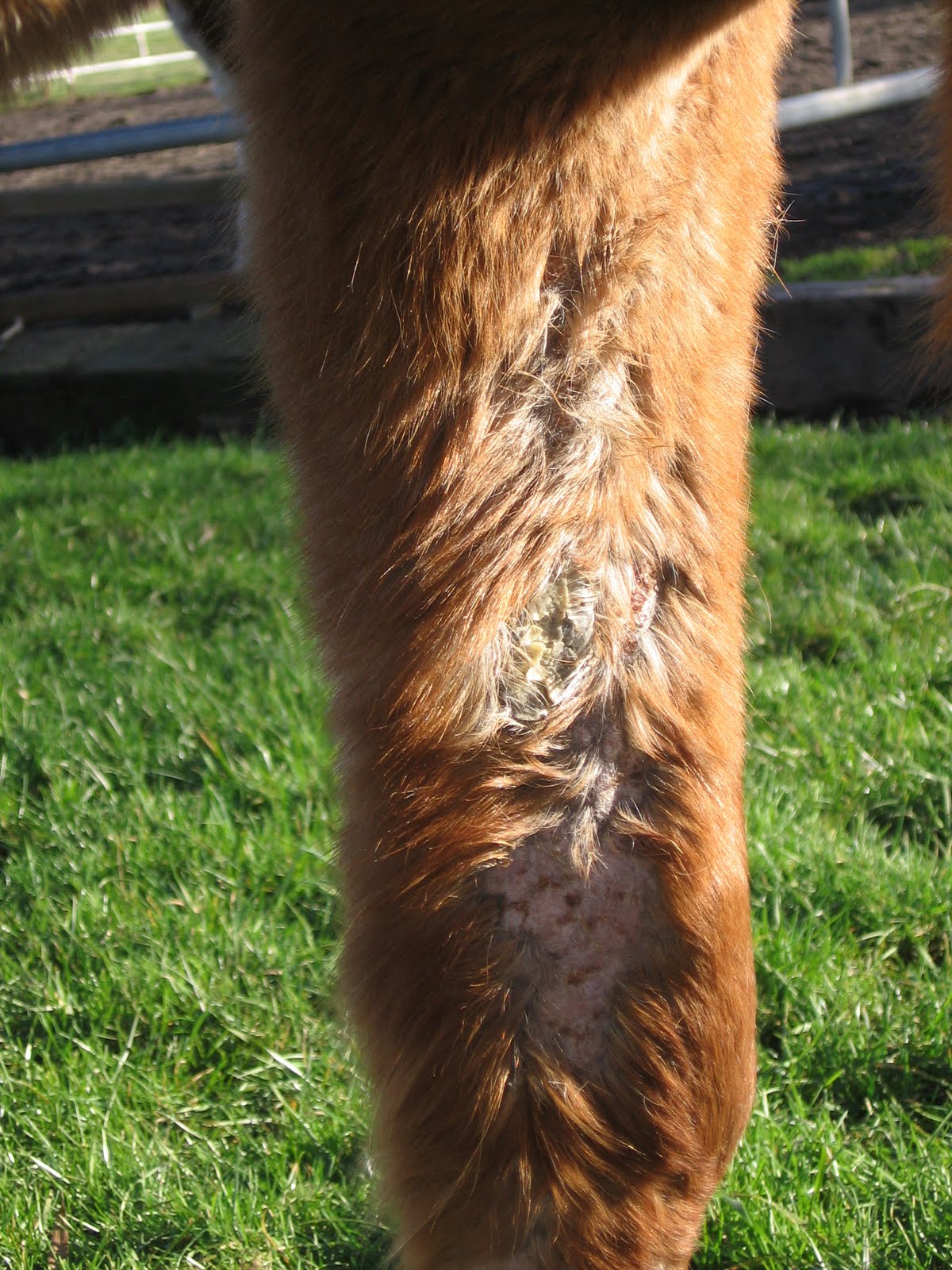
 What could have potentially been a deadly infection has turned out to be a controlled skin condition that I'm hoping will heal up as fast as it broke out. Rose is going to be moving to my best friend's place nearby for her 2nd and final retirement. All attempts to ride her have been futile, as her shoulder arthritis is very debilitating for her if she tries to do more than a trot and especially with a rider on her back. Ironically, her feet have done wonderfully with the trim and she no longer stands with her weight forward due to painful heels. Her toe walking now is from the stiffness in her shoulders from years of walking incorrectly.
 Rose continues to teach me about the horse and especially the senior horse. They are very sensitive to illness and injury and we must always be on the alert for any changes in their health. I think she'll enjoy her new home and will hopefully get to spend time again with Sally, my other aging girl. My dermatologic (skin) challenge with her has been seborrhea dandruff but I'll leave that story and photos for my next blog.
Subscribe to:
Posts (Atom)