Saturday, August 21, 2010

Out of Retirement


It's been a very busy summer. Since returning from the clinic in Yelm in June, a lot of changes have occured. The first one has been a monumental one for my first horse, 29 year old Rose, who for the last seven years has been retired out to pasture, spending most of her time with Tetley, who is more than 30 yrs old. While I was out of town Rose was given two new pasture mates, one of whom was given to the owner to ride, the other, just visiting while his pasture was being sprayed for weeds. Initially, the young geldings were separated from the old folks by a temporary fence, made partially from old barb wire. Rose, being the beauty that she is, immediately attracted the two young geldings' attention. Unfortunately, Rose was more than willing to back herself up to the fence, raise her tail and "show off" her stuff. When the geldings tried to reach across the fence to connect with Rose, she kicked and caught her hind leg just inside the hock on the wire, tearing the flesh and creating a nasty open wound.

Initially, I was called to attend to Rose and to make daily visits to clean and dress the wound. But, after the visiting gelding left and the new resident gelding was allowed to mingle with Rose and Tetley, it was evident that the threesome was not going to work. The young guy constantly ran Tetley off and made Rose his own. Soon, she was calling me to take Rose out of the pasture and if possible find her a new home. After seven years, I wasn't sure where she could go and have the same freedom and daily movement she needed with the safety of a calm, experienced, docile pasture mate.

As fate would have it, I'd recently met a woman through my job whose mother owned the stables around the corner from my friend's barn. We'd talked and I immediately found her to be friendly and upbeat. When I tried to think of a place to bring Rose, it occured to me that the closest place, most convenient, would be at her stables. Luckily, when I called, she had not one but 3 stalls available! I moved Rose two days later after having the vet give her a "cocktail" of sedatives to make her ride in the trailer less traumatic. Rose has never liked riding in the trailer and with her injury, plus the stress of leaving her home and good buddy of 7 years,I thought it best to make her travel to her new home as comfortable as possible.

Just before we left, the vet took a look at her injury, now 4 weeks old and recommended a spray called Vetericyn VF (twice as potent as the over the counter version), used to help heal wounds. He had not heard of it before and said he was not sure if it would work, as the ingredients were simple saline and sodium phosphate and hypochlorous acid. It claims that it has an "oxychlorine compound" similar to what the animal's immune system produced. I was the first client to whom he was selling a bottle and he asked me to report on her progress. Well, within 1 week, the wound had reduced in size by one third and I didn't even cover it or bother to give her the sulfa oral powdered antibiotics he gave me. (I'm skeptical when the same antibiotic is given to horses for everything and would rather not expose them to it unless absolutely necessary). It's now been 2 mos and the wound is down to a dime size pink scrape, and like other horse wounds I've seen, seems to have created it's own structure with lines of demarcation filled in with new colored skin and hair. Nature is amazing.

Now that Rose is in a stall at a stable, she is on a daily schedule very similar to her retirement: out at 8 am with a pasture buddy (a young horse suffering from navicular syndrome, who after 6 yrs of failed treatment, including surgery and corrective shoeing, has become one of my trimming clients-more on that in another blog....). She comes in at 8 pm and in between has been enjoying the sunshine and the freedom of a two acre turnout.

The big change has been that,now that she is in my care, I have begun to exercise her on the ground and I noticed something interesting. While comfortable out in pasture on her bare feet, she cannot handle the pounding of heel first landings at trot and canter in the arena. It turns out, I had been trimming her feet to fit a horse standing still or standing on soft pasture. She really has not completely developed her heels and the inner structures sufficiently to be worked at more demanding gait or unforgiving surface. So....I am reworking my trim with her and re-evaluating my techniques. I've gone back and read over and over the article from Pete Ramey, "Heel Height, the Deciding Factor." and now it makes sense. Just because it says to keep the heel approximately 1/4 inch off the sole and give the coffin bone a ground parallel angle while standing still (or close to it), this does not work when we have a horse who's heels are mushy and underdeveloped. It just sends them up on their toes, wearing down the wall unevenly and slowing the whole process to a stop.

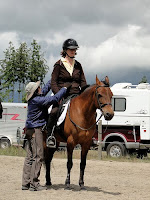
I'm now putting boots on Rose as much as possible and will be leaving her heels a little higher (maybe up to 1/2 inch) until she shows that she can walk, trot and canter on the ground she lives and works on (mainly arena or grass for now). It's exciting to see her move out more and I've actually saddled her up and walked her around. She is so smooth and so comfortable to ride on. I'm so thrilled and I hope she will enjoy the new activity as well. Maybe she hadn't planned to come out of retirement, but I know she has a lot of good years ahead of her. Maybe by helping young and old riders gain their confidence and find that balanced seat, as a lesson horse. You're never too old to get a new job. WELCOME BACK ROSIE!!!!

Here's a video of my daughter Laura riding Rose for the first time in seven years:

Tuesday, June 29, 2010

The Power Seat- "One Stop Shopping"


I don't know if you're old enough to remember the days when in order to get all of the items on your grocery list, you had to go to at least 3, if not 4 different stores. There was the butcher shop, where you bought your meat, a bakery for your bread and donuts, a produce stand where you would buy your fruits and vegetables and if you needed anything for your medicine cabinet, you had to go to the "drugstore". It was time consuming, inconvenient and frustrating if you'd forget something and have to make another trip across town.


Well, now there's a simple solution for shopping-the superstore or supermarket! And just as remarkable, is a simple straightforward way to find your POWER SEAT when you ride. By engaging the supportive, powerful CORE muscles (no, I mean the REAL core muscles) of the psoas, located deep inside the body, you'll be able to sit deep in the saddle, wrap your legs snugly around your horse's barrel and keep your feet exactly where they need to be: grounded with equal weight in the stirrups. You will breathe softly and maintain your balance, and your joints will flex and absorb the motion of your horse.

Thanks to the brilliant, yet simple explanation by Karen Irland, Level 4 Centered Riding Instructor and the genius of Tom Nagel's simple book, "Zen and Horseback Riding", (see previous blog entry, "It's Like Breathing Out and Breathing In") riding is even more fun than I imagined. Although, I had read the book prior to attending a recent CR clinic with Karen, her explanation of how to put it into action made it come to life. Now I can't believe how easy it is, not only to use it in my own riding, but to teach it to others, in MINUTES! You don't have to constantly adjust your body as individual parts. You know, just as you fix one, you have to think through another method for adjusting the others. Not anymore....


The most dramatic thing for me was realizing just how much I tighten my abdominal muscles when I ride which immediately pulls you on to the front of your pelvis or pubic bone, instead of on your seat bones . This in turn, limits the movement of your hips, inhibits breathing, creates brace in your lower leg and removes your inner thigh contact. You must soften the abdominals, even if you have to poke yourself with your fingers and breathe through your mouth to encourage the relaxation. It took several attempts to really feel it and keep the softness. Once the abdominals are soft you'll begin to feel yourself sitting in the saddle with knees flexed and lower legs wrapped around your horse's barrel.


Now comes the real key to it all: engaging your psoas. This big muscle on both sides of your spine connects just below the last rib at your back and stretches deep in the pelvis or bowl in your lower body (your bladder is at the bottom of the bowl) and then connects at the top of the big leg bone, called the femur just where we feel our thighs . With your abdominal muscles "mushy" you can lengthen your spine and the stretch the psoas down easily (think of bringing your belly button back towards your spine-you'll initially feel like your slumping-this is your pelvis rocking as you put more contact on the mid portion or seat bones). This immediately tones the inner thigh muscles which creates improved contact with the horse. With the psoas engaged, you are now sitting on your seat bones, instead of pubic. And with your abdominal muscles relaxed, you are able to breathe better and move your hips easily.

Karen was kind enough to remind me over and over, to soften my abdomen and engage my psoas. An additional benefit to allowing this to happen is that when the hips move easily, so do the feet. When you tighten and tip forward on your "pube" as she called it, you brace in the stirrups and bring your heels too far up or too far down, depending on which direction you tend to brace and with it, you lock your hips and knees. But, with the psoas engaged and joints all moving (hips, knees and ankles) it becomes very clear that these natural shock aborbers are more efficient.


The comfort we feel is reflected in our horses movement as well. Now you can feel the left and right, up and down movement of your horse's hips. Your lower legs, thighs toned and secure around your horse can make imperceptable movements to cue your horse and as you remain grounded in your stirrups, you can rise at the trot, allowing your knees, hips and ankles to absorb the motion. Transitions become a simple act of inhaling to warn your horse that something is about to happen and exhaling as you engage your psoas and complete the transition.


Soften abs, lengthen the spine, feel better contact with seat bones, tone the inner thighs for better contact, feel the freedom of movement of all the joints with feet grounded. You've achieved the POWER SEAT with just one simple act: engaging your psoas. It really is one stop shopping! Best of all, it's easy to share with my students and they can tell the difference immediately. Try it and ENJOY!

Thursday, April 29, 2010

Singing on Horseback


I was riding home from teaching a riding lesson yesterday and heard a talk show on the radio that was discussing how to make the most of your voice when you sing. The guest on the show was a jazz singer who teaches voice lessons in Virginia. When asked what advice she gives her students for creating the best sound from their vocal cords, she mentioned an exercise that releases tension in the jaw and drops the tongue, so that it lies flat on the lower teeth. Once you open your mouth, as if to yawn, you will find it easier to produce the sounds, starting with a vowel, for instance, with minimal effort, but maximum results. She teaches that tension is the enemy of the singer. Muscles that are tight cannot efficiently create the energy necessary to perform.


In addition to my passion for horses, I have a great love of music and singing and at one time dreamed of performing professionally. I was very shy when I was young and had to back out of a 5th grade performance of the Beatles classic, "Yesterday", after becoming sick to my stomach with stage fright. I tried again in college, singing with my boyfriend's band at a dance and somehow made it through without fainting. I even took a few voice lessons from a woman in New York city in my early 20s but other than singing at a friend's wedding, have kept my voice a well kept secret. Now, when I find a rare moment of quiet at home, alone, I turn on the ipod stereo and with my own personal microphone and small amplifier, I "practice" my singing. I'm not sure who or what I'm practicing for, but you never know when someone else close to me is going to get married.


As I listened to the radio and the voice instructor's explanations, I realized that recently, I've been using more body awareness and release of tension in my singing to create a much stronger, much more "elastic" quality to my voice, able to move up and down the scales with less effort. It seems that since I've begun my life in centered riding, I've noticed how the release of tension, increase in body awareness and centering , with breathing and soft eyes can improve my singing and for that matter, can be applied to ANY physical activity that you wish to accomplish proficiently and with minimal effort.


As an instructor, it is necessary to keep a large arsenal of tools at your disposal to assist in explaining particular concepts to students. I don't currently have any singers as riding students but I do have students who have engaged in other athletic activities. Knowing how to explain the correct use of the body and releasing tension while participating in a particular activity like riding or singing, is the most challenging part of my job. Probably, because it is the most challenging part of riding for me.

Recently, when I was riding, it occured to me that as a health professional I deal with patients who are nervous, scared and in pain at times and my experience allows me to remain calm, confident and reassuring in order to be a part of their care. But, I had to have training and instruction before I could become an experienced professional. They don't call it "practicing medicine" for nothing.

For example, in order to qualify to perform a procedure in which I examine the colon using a flexible scope, I had to have specialized instruction and training. In the beginning, I was moving my hands and going through the steps as they had been explained to me, but I was not really understanding the big picture. My body would tense as I struggled to find the correct position, inadvertently forcing the scope to move against resistance. Of course, the feedback I received from my patients when they felt discomfort, was immediate. Because I am outside of the body, able to look inside only with a 2 dimensional screen, I needed to have a sense of what was happening as I moved the instrument in one direction or the other, almost through "feel". As I became more adept at the physical skills I needed to complete the exam, I found I did not have to think so hard about what my hands and my body were doing-it became automatic. The tension was gone.

And so, in every aspect of my life and now with riding, I must learn to find the focus and the emotional center that creates the calm and the relaxation, once I have the coordination and physical skills to ride . Then I can allow the automatic part of my brain, the muscle memory as it were, to take over. Whether I'm singing, scoping or riding, it will make for a much more balanced, harmonious experience for all concerned. And if I turn up the tunes while I ride I can SING AND RIDE! Wouldn't that be a joy!

Monday, April 26, 2010

Natural Hoof Care-One Woman's Story

This article was published on the website of Dr Suzan Seelye at www.quantumvet.com . Suzan is devoted to the healing of horses through holistic methods, as well as educating horse owners regarding their horses health. It tells the story of my experience with natural/barefoot hoof care-C.M.


The first time I heard about Pete Ramey and Natural Hoof Care was when I saw his name listed as a guest on Clinton Anderson’s TV show. It said he would cover two topics, laminitis and navicular syndrome and that he would show how, with the barefoot trim, he could resolve both problems. I couldn’t believe it. If this was true, then it was only a matter of finding someone who knew his techniques and who would “cure” the horses affected by these crippling conditions. Little did I realize, in just one year after seeing Pete on TV, that someone would be ME and that I would be trimming, not only my own horses, but also those of several of my friends.

It just so happened that at the time I first saw Pete on TV, I owned two horses, one with laminitis that had gone to founder (rotation of the coffin bone or distal pedal bone), another with navicular syndrome. I had never been satisfied with the shoeing or veterinary care I’d received over the years and was all ears when Pete said “I’ve never seen a case of navicular that wasn’t resolved with this trimming.”
Over the years, my first horse, Rose had developed worsening lameness and had been wearing shoes with pads, due to a condition I did not quite understand. My “real job” as a medical professional gives me a distinct advantage over a lay person when it comes to recognizing anatomical terms and understanding disease processes. But, the explanation as to why Rose was lame, never made sense. The farrier said she had a condition that weakened the tendons in her front feet at the heels, that then damaged the nerve that ran along the tendon and that eventually it would break down the navicular bone.

Articles and books from vets and farriers had a similar description of the process but would sometimes reverse the order in which it occurred. Was it the damage to the bone that caused the tendon to be stressed causing pain or was it the damage to the tendon that caused pain and damage to the bone. The proof was in the xray, they would say or in the test that was commonly done in which the heel was pinched with metal grabbers. If the horse pulled away, then there was damage at the heel. Or, you could prove that the pain was at the heel and the navicular by “nerving” the horse, in other words, severing the nerve to stop the pain. Unfortunately, you might also eliminate the horse’s ability to feel the ground at his heels. And this was no guarantee that the whole process would not continue-it would just stop the pain. Rose was subjected to a special shoe with padding, but the process continued. I was told that she was born with bad feet and that she was “wolf bait”. Her hoof walls would crack and chip and I was told that it was because they were white hooves and everyone knows they crack easily. Rose began walking on her toes more and more, heels just too painful for contact with the ground, pads or no pads. The farrier said she would only worsen with time.
Rose was mine for 10 years from 1988 to 1998, until I finally sold her to a breeder, convinced she’d never be sound enough to be ridden again.
After selling Rose, I went about looking for another horse that I could turn into my trail riding buddy. I was still learning about horses and horse behavior, still learning how to ride and didn’t have a lot of money to spend on a new horse. I had just been exposed to a few videos from some guy named John Lyons and my friend had taken me to my first horse expo where I began hearing the term “natural horsemanship.” I was at the beginning of a journey that continues to this very day, when I saw an ad for an 8 yr old Morgan Arab mare, written by the young girl who had rescued her from a neighbor. Her description of Sally was so sweet and so full of wonderful details of her personality, that I had to go check her out. She was tall and thin with big brown eyes that were soft and gentle. The young girl’s mother said she would whinny when they came to feed her and that she got along with every animal at the place. But, she said, she had developed “founder” from eating fresh grass in the spring after a winter of very little to eat. She was obviously malnourished and her coat was dull. When I brought her to my stables for a week to “try her out”, I had the farrier check her feet-the same one who had put shoes on Rose. He said and I quote “I wouldn’t pay $50 for this horse.” Let’s just say, I paid a little more than that.
In the beginning, I left Sal barefoot and had a friend’s trimmer do her feet. Then I switched to a different one because someone else told me he was good. What did I know? I wasn’t even sure I understood what founder was, because it seemed that if Sal’s bone was rotated in her front foot that it would be permanent. But she seemed to do well. I began working with her using the techniques my friend had showed me and she lent me more videos, including one from a guy named Pat Parelli. When I finally got up the courage to take her on trails, I was told she would need shoes. The same people who advised shoes, also advised me on feeding Sal, including grain and alfalfa. Sure, sounds good to me. Only, it wasn’t good for Sal. She developed lameness in the spring and after being told that she’d strained a tendon or that she had a bruise on the sole of her foot, I kept her at rest for a while. She grazed on pasture and continued to eat the rich diet that everyone else in the barn fed their horses.

I will never forget the first time I saw Sal laying down in her paddock, unable to get up, her feet swollen with laminitis. Those who’ve studied the horse in its natural environment, say that a horse will never lie down unless they are in severe pain. Their only real escape from predators is to run and to lie down is to relinquish this means of escape. Sal would not get up. A vet diagnosed laminitis and suggested I use butte for pain and have my farrier look at her to adjust her shoes and/or trim. I called the farrier who had taken care of Rose, as he was considered a corrective farrier and seemed to understand what I was talking about. When he first trimmed and re-shod Sal, he began explaining the process of founder. He said that it could be from the spring grass or it could come from vaccines that we give our horses but that he could correct the angle of the pastern bone so that she would not stand on her toe, as that was now rotated down when the most distal bone in her foot, the coffin bone, moved downward. I wasn’t clear on how that had happened again and I was not sure if this was a recurrence of the same condition that she’d had when I bought her or a worsening of it. Was he going to MOVE the bone by putting these “heart bar” shoes on her. And why did he have to chop so much of her hoof wall off at the toe? All I knew was that it got Sal up and going again and as long as she was moving, I was happy. It didn’t even matter that he charged twice as much for the shoes on Sal as he did for “normal” shoes.
I moved to another stables and continued to ride Sal regularly . Our trail rides, while full of stress and struggle in the beginning, had become pure joy for both of us. I could tell Sal loved to run and I would let her move out on the straightaways, through the woods and up the hills. I fed her more grain and alfalfa, thinking she needed the calories to compensate for what she burned up on the trails. She was given carrots when she was a good girl. In addition, I found out about “horse cookies” that everyone raved about, full of molasses, used to treat their horses. Slowly, without knowing it, I was sending Sal into a downward spiral-killing her with kindness. When she first lay down in pain, the vet said she was suffering from colic. But, this was no colic and when the second vet came out, he confirmed that she had laminitis-again. He suggested that her diet may be the problem, but did not think she needed to be totally off grain. Maybe I could soak the hay. And he would do blood tests to check for Cushing’s (a pituitary disorder) and thyroid disease. In the meantime, I should place Styrofoam inside her shoes so she had more cushion on her toes where founder caused the most pain. I could give her butte.
I called out the farrier. He left the shoes on and said he’d be back when her pain subsided. When the vet said he thought it was Cushing’s based on Sal’s test results, I asked about treatment. Pills, he said, for the rest of her life. She was only 14 yrs old. Before I agreed to give her the pills, though, I began researching laminitis and Cushing’s on the internet. I had found an article months earlier in a horse magazine, written by a vet, about a condition called Metabolic Syndrome, similar to human diabetes, in which horses become resistant to the insulin in their body as their sugars increase, with a diet high in carbohydrates found in grain, molasses, alfalfa, orchard and timothy grass and treats like apples and carrots. I read everything I could find on metabolic syndrome and what I discovered was that many vets believed there was a connection between a high sugar diet and recurrent laminitis. And it seemed to occur in particular breeds that genetically were designed to eat very sparse diets-breeds like Morgans . Sal’s foot problems weren’t from some glandular disease, but instead, from feeding her too much SUGAR! I contacted the vet, who seemed to know nothing about metabolic syndrome and told him I would not need his pills. I would not be calling him again. I found a low carb diet for Sal with beet pulp and rice bran and put her on the driest hay I could find. And no more carrots and molasses cookies.
Weeks turned into months and with every shoeing, I could tell that Sal was not improving. She had now been wearing heart bars for almost 5 yrs. I asked my farrier why her “lamellar wedge” would never grow out and he had no explanation. He began asking me about the strange gray mush I was feeding Sally and what it had to do with her feet. I began noticing Sal’s limp in her hindquarters and did not know what to make of it. My beautiful horse, my wonderful trail buddy, my four legged friend was now unable to run with me and I would have to retire her to a life in a dry paddock. I began looking for another horse.


Sally's Feet in Heart Bars (This is after FIVE YEARS of "corrective shoeing")


Ironically, I found a horse in the same stables where I boarded Sal. She belonged to a young girl who had left her on pasture all year round. The mare arrived, obese, thick crested and unshod, and the girl told everyone she was trying to sell her. She had been unable to pick up her feet as the horse would become fearful and kick out, so she had not trimmed her in over a year. A few days before the young girl was about to advertise the horse, the mare lay down in her paddock. The beautiful Morgan was suffering from laminitis. I offered to buy her immediately, knowing I would be able to care for her and feed her the diet she required. Desperate to find a home for a horse she knew no one would buy, she gave me Chanty for practically nothing.
It was about this time that I watched Pete Ramey and soon after contacted a hoof care specialist and begged her to come and look at Sally. And, if she had time, to check out Rose, who I had bought back 4 yrs earlier when a woman called me and asked if I knew what to do with this horse , starved and lame, purchased from an unscrupulous woman breeder, as a Christmas present for her young daughter. I said I’d buy her back from her, and brought her home with me. She began a life of retirement on 8 acres, which she shares to this day with her buddy Tetley.
The day Sal’s shoes came off, I cried tears of joy. Although it would take another 2-3 years of learning to trim through clinics, home study and trial and error, I would eventually learn several things about Sal and Rose’s feet that would relieve them of their constant suffering and allow the hooves to revert back to their natural form and function.
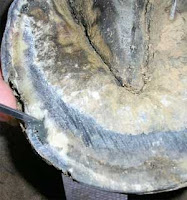
First of all, for several breeds, diet is very important. There are “easy keepers” who require very little to sustain them and who will develop significant health problems on high carb diets, one of which is laminitis. The sugars create toxins which break bonds in the live tissue of the lamina which connects to the hard coating known as hoof wall. With damage comes inflammation, with inflammation comes distortion of the wall, pushing it out and away from the bone deep inside. Once this swelling is under control and the separated hoof wall is trimmed away and new connected hoof wall is allowed to grow down from the hair line, the foot will recover. Founder is not forever! A hoof must be trimmed from the bottom, balancing the heels and toes, allowing the natural concavity of the hoof to form from a thickened callus sole, not carved by a farrier’s knife. Shoes that artificially realign the bone in the foot with the pastern bone are just that-ARTIFICIAL. But laminitis and separation occurs more often than we think and is the result of unnatural forces pulling the hoof wall away from its attachment. It is the most common condition seen in horse’s feet. Cracking and splitting similar to what Rose would have, was not caused by white feet. It was because her hoof walls were left too long, in order to accommodate a shoe. Every time she stepped on a hoof wall that was abnormally long, the forces against her hoof pulled the hard covering away from the lamina. Try standing on long fingernails and not break one as you balance yourself, walking on your hands.


Hoof Wall Separation


Second, anyone who tells you that all trimming is the same, has not studied the horse’s foot in depth. Even those who study and choose to trim as nature shows us, may continue to project their own vision of the hoof based on their studies, instead of working with the hoof in front of them. That is to say, if the trimming is not improving or it is not maintaining a healthy, sound horse, then you must step back and reassess your trimming or your trimmer.
Finally, I learned exactly WHY Rose couldn’t walk on her heels and what exactly had caused her “navicular syndrome”. And, best of all, I was able to trim her myself and eliminate the problem altogether, just as Pete had claimed.
When Rose was 2 yrs old, someone decided she needed shoes in order to begin training. (I bought her when she was 8) When horses wear a shoe, the frog at the back of the foot does not make consistent contact with the ground. In addition, the shoe can potentially squeeze the back of the foot and “contract” the heel so that part of the frog, which should be up to 2 inches wide, is folded up into the foot. Underneath the frog is a mass of tissue called the digital cushion. It is soft and mushy when the horse is young and under 300 lbs. As the horse matures, and makes repeated contact at the frog with heel first landings, this digital cushion will harden and on top of it is the tough frog with a surface much like the rubber tires of your car in which the horse can push off with each step. It creates a secure, non slippery surface that is able to step over uneven ground.
Rose’s digital cushion never developed entirely. Year after year, shoes “protected” her feet and her heels remained soft and mushy. As she matured and began a life as a cutting horse, she was asked to use her heels to slide and stop rapidly. But, without solid, hardened, wide frogs to absorb the concussion of her feet to the ground, she became sore. She would then attempt to relieve her pain by attempting toe first landings. This would further inhibit the development of a solid digital cushion and if she were to put weight on the heel, she would experience more pain. And on and on….Rose has now gone 4 years without shoes and pads. She is 29 years old and suffers from arthritis in her right shoulder from walking on her toes and running abnormally in shoes for years. She stands and walks straight up with a heel first landing and her frogs, wider and harder than ever before. She never suffers from splits and cracks-her white feet as hard as any black feet in the herd.


Sally's Foot on the Mend
Sally continues to need careful monitoring of her diet to insure that she does not suffer from recurring bouts of laminitis. With correct barefoot trimming I’ve been able to grow a well connected hoof, with a thickened callused sole and ever widening frogs. Sally suffers from pain in her hocks as well as in her back and hips, no doubt from unnatural shoeing that placed stress on her joints. She is now benefitting from massage and stretching before we exercise. I ride Sal on hard road, with gravel and uneven surfaces now, but in the beginning, I used boots until her soles thickened and she was able to tolerate the ground we rode on. I highly recommend boots and anyone who trims and does not recommend them is not being realistic with the owner about what it takes to transition to going barefoot.
So much of what we do to our horses is the result of ignorance. We see and hear what others are doing and saying and figure, it must be right, otherwise, why would they do something to harm their horse? But nowadays, there is so much information available to us. There are people who are out there with answers and if we care about our horses, we’ll keep looking. Don’t go to one source, or read one book. Learn as much as you can. Question those who claim to be experts. Don’t take my word for it-learn first hand from several people who’ve struggled with the same conditions. But, most importantly, listen to your horse. The lameness you see today is usually the result of damage done YEARS earlier. Today is the day to find out if those feet can handle the demands we put on them from now on!
If you go to Pete Ramey’s website www.hoofrehab.com you will find an incredible list of resources, including his videos on trimming. You can buy them from him or rent them at www.yourhorsematters.com

NOTE: I apologize for not having any current pics of Sal but have not taken any of them recently. I will update this article with photos and discuss BRIEFLY some more specific issues in future newsletters-C.M.

Wednesday, March 24, 2010

Carry Your Hands, Carry Your Hands, Carry Your Hands

Over the weekend I had another opportunity to work with an amazing teacher, Dawn Ruthven, a Level 4 Centered Riding Instructor . What did I learn from this clinic you ask? You got it! When was the last time you had to think about carrying your hands? Well, frankly, when there is a horse’s head at the end of those hands! But, it turns out when you use your elbows flexed at about 90 degrees heavy enough to “dig post holes” you don’t have to worry about it. Your hands should be floating, with a light quality, light enough to write your name. The elbows support while the hand gives the aid that you need.


Does your horse always feel light in your hands?-well, maybe for a short time and then for awhile he may ask you to hold him up. Your job is to support your horse, to give him something to balance on. So, raise the outside rein until he feels weightless in your hands, hands that should be like a sponge, elastic and playful. Keep the thumbs tented to allow flexion at the wrist. Your pinky fingers should be closer that the index fingers. You should be able to look into your hands.

When the elbows are NOT doing their job, the hands become heavier. Anytime you feel weight in your hands-remind your elbows to take up the weight, which lightens your hand. And, when there is activity behind, the hands will lighten, so keep the engagement of the hindquarters with a lower leg long and shaping the horse’s body. If you keep the connection in the elbow, your horse will develop greater SELF CARRIAGE, as he strengthens his hindquarters.

This all must start from a quiet, relaxed attitude from the moment you begin your ride. We must get organized and comfortable and “find our elbows”. Don’t forget to explore your position and contact. You are responsible for the quality of your horse’s pace, so remain steady on the outside rein for support while using the inside rein to flex and lower the head and ask your horse to step forward. It is the anatomy of the horse’s muscles in the neck that allow the horse to drop his head when it is flexed to the inside.

It all becomes a balancing act between support in the front and energy from behind. Imagine going through a stream on slippery stones and instead of getting a steady arm from your friend to keep you from losing your balance and falling, you instead find shaky and inconsistent contact with what should be a supportive hand. It would be distressing and that’s exactly what your horse experiences every time you drop your hands. Give the support he needs and he will use himself with energy. Impulsion comes from the hindquarters, so remember to not let the horse start off from his front end. That seems contrary, but try it by kneeling and “walking” on all fours and then pulling yourself with your “front legs” (hands). It leaves the “back legs” dragging behind and feels very awkward. Instead, initiate the forward movement with your BACK LEGS. Don’t drive the front end away but energize the hind end. It is the ENGINE that drives the horse and it is in his hindquarters!

When your horse is balanced, tracking up with his nose just in front of the vertical, there should be no tension in your back or his. Tension will lock the muscles. Keep equal weight in both stirrups and as you post, don’t push off the stirrups. Come up at the post, centered over your horse, and imagine “dropping the ball” from between your knees-this will lower your center of gravity to keep the weight over your horse’s center. Falling forward will only put you and your horse off balance as the posting gets faster and faster, followed by your horse increasing his pace to keep up with you.

This all became very clear to my students this week, when, fresh from my own learning experience, I presented this information to them. I really like the image of helping a friend or spouse (two of my students happen to be a married couple) through a stream of slippery rocks. I took them to my favorite park and had them go up and down hills, all the while, maintaining contact with the horse's head flexed at poll (which means the back is up,the hindquarters are taking the weight) with soft, quiet and controlled pace. The more unbalanced a horse is, the more they need our help "crossing the slippery rocks."

It was a fantastic clinic and I am looking forward to going back in May for another opportunity to work with Dawn and show her how well I can CARRY MY HANDS!
MOST OF ALL: HAVE FUN and ENJOY YOUR HORSE EACH AND EVERY DAY!


4/5/2010: Dawn wrote me after reading the YHM newsletter and this blog and said, "Thank you for your very kind remarks ,really happy that you got such a
good feel.just keep reminding yourself that the elbow is the natural
buttress,the hand the communication center,through the communication the
hand becomes a love affair".cheers Dawn

Sunday, March 14, 2010

"Habitual Tension"


Just that phrase, "habitual tension" sounds uncomfortable. Who would make a habit of being tense or why would you allow it to continue day in and day out? As a health care professional, I see the results of "habitual tension" on my patients. People with headaches, stomach pains, heart palpitations or racing hearts, pelvic pain, sleep disorders, and on and on. At first they don't connect their physical symptoms with the stress that triggered it. But, the more I delve into their history including work and home life, as well as their own personal and family health history, the more it becomes apparent that their physical symptoms are part of the big picture, which is stress and tension. Sometimes, they become so accustomed to the feelings in their neck, back, stomach or head that it becomes "normal." They may take medication to dull the sensations, until nothing works and it affects their daily life. What may seem like something new in their health history, may have begun months or even years earlier and living with it has simply become habit.


What does this have to do with our horses and my recent trip to a Peggy Cummings clinic? Well, actually, a lot! We've all heard of horses who have colicked or developed ulcers from stress and if you've seen the physical signs in person, you know how uncomfortable the horse appears; rolling and pawing, standing with stomach bloated, reaching back to poke at their belly as if to say "what is that I'm feeling and how can I make it go away?" But, what about stress and tension in our horse that presents as something subtle like walking with stiffness in a left front shoulder, not turning or bending on a lead rope either towards you or away from you? How about swinging their head toward you back and forth while standing or walking next to you. Is this disrespect, is it resistance or attitude or is it our horse's way of saying, something hurts, please help me?


Unlike the human patient, we can't elicit a detailed history from our horses, and may never pinpoint the exact moment when it began, but what is now apparent to me after spending the weekend watching Peggy Cummings "connect" with horses, is that much of the tension that we see and feel in our horses starts the minute we put a halter on them. What? That would mean that even as early as the first day of imprinting, if you are so inclined to engage with your foal in this way, you may have begun to create tension in your horse.


But how the heck can you handle a horse, move them from point A to point B or direct their movement, if you can't put that physical restraint on them? Well, apparently, it isn't the rope and halter that creates the tension, it's the "jerk" at the other end. (chuckle, chuckle). Seriously, if you've been around horses long enough, you've either personally pulled on a horse or seen someone else do it. Many "natural" horsemanship trainers advocate quite a bit of pulling and jerking, especially if the horses behavior includes running, turning, kicking or lifting themselves off the ground in response to their handlers' requests. I thought that it was necessary to show the horse who was in charge and because they were big strong animals, that it couldn't be that painful or harmful. But, it begins a pattern of tension and resistance that can occur even when there is no direct pull on the horse.


Horses know what happens before what happens happens, which is to say, they are able to anticipate something about to happen, once they recognize the event that occurs just before that something. So, if every time you walk into your horses area with a halter and lead rope, you then put it on them and pull them or take them out to the round pen, arena, trailer, etc, the horse soon learns to anticipate the activity outside his stall with the lead rope and halter in your hand. If the experience is one of physical stress and strain to the horse or their handler lacks the confidence and skill to create a sense of safety and comfort for the horse, it learns to associate those experience with discomfort or even fear. Muscles tighten, the head and neck recoil, the acids in the stomach flow, tension builds. Now you add riding and you put a poor fitting saddle on the horse with a rider who has little or no balance and a whole lot of her own tension. Day after day this scenario is repeated and "suddenly" you've got a horse who is difficult to handle, lame or shows problems under saddle. If they could talk and drive themselves, they'd be in my office looking for help.


That's where wonderful people like Peggy Cummings can help. Her methods of "Connected Groundwork" use soft, slow techniques that create a way to release tension and overcome bracing. At first, it seemed as if she was holding a horse too close to their face and head on a halter with fleece cushions that would encourage leaning and pushing, but when done correctly, it gives the horse the skills to carry himself and connects the hindquarters which create the power, to the rest of his body. It was subtle and elegant. There was a dramatic improvement in several of the horses, most evident in a big warmblood, whose tension in the neck and poll had created a very dangerous habit of swinging his head rapidly and vigorously towards his handler. Peggy very calmly explained that he was looking for a place to push against to release the tension. Skeptical, I couldn't stop thinking that this horse was using his head to push Peggy away and avoid being asked to move his body, which is true, but it was because he felt tension and pain. He was perfectly happy to move, once the brace and tension was out of his body. With just two 15 minute sessions, Peggy accomplished exactly that. BEAUTIFUL!


The riding just flowed from these wonderful beginnings and now I have yet another way of enriching the relationships I have with my horses and the horses of my students. If this has helped me to relieve some of the tension in their lives as they've helped me relieve stress in my life, then it will be a fair exchange. Breaking a habit is not easy, but the first step is in recognizing it and doing something different, hopefully improving on the situation. Next time your horse acts up, resists, pulls to the right, trips, moves out slowly or any host of "issues", ask yourself, where is the tension? What is my horse trying to tell me?
P.S. One thing that was not addressed was the horses feet. Several of the horses were shod and both shod and unshod horses showed signs of heels that were too low, toes too long in the front with obvious low coffin bones and subsequent toe walking. The effect this has on their knees, shoulders and back cannot be minimized and creates its own tension and resistance when left unchecked. Assessing hoof health is another part of the "big picture". C.M.


Monday, February 22, 2010

Spring in Paradise

Just when I thought that all of the rain was going to get me down, the weather has been magnificent (60 and sunshine yesterday). My daughter was home from college and it was a rare treat to be able to take Sal and Chanty out to the beach and ride with her. She doesn't get on the horses very often and she commented that she was not used to using her inner thigh muscles to ride....and she's only 20 years old! Is it any wonder that those that begin riding over 40, go through a great deal of physical strain to get it right. It just proves that it is not about "just sitting" on the back of the horse. If you're doing it right, you are exercising and when it goes well and you get off without being sore, then you really know it's working for you!

I had been riding up and down the driveway at the new stables, while the arena dries out and the surface settles. At first I thought that it would not be the type of workout that I was looking for-I was wrong. Riding straight lines, then curves in the road (this is a LONG driveway) with the change in surface height was perfect for strengthening and balancing my horses' bodies. There was one very big puddle that Chanty did not want to go through. We worked on it several days in a row and she is now much braver and able to trot through. She is doing circles around the pile of gravel and the uneveness and change in surface, really challenges her to keep her balance and stay at the same gait with speed and rhythm maintained. Who knew that riding on the driveway would be the best workout she's had yet!

But, the real dream is to complete a "Paddock Paradise". This is an idea and a book, first published by Jaime Jackson, a natural hoof care specialist who is now the executive director of the AANHCP (Association for the Advancement of Natural Hoof Care Practices). The idea is to keep your horse in as natural an environment as possible. Jackson based his ideas on observations made with the wild horse. He was able to determine that the horse normally travels along particular paths that take him past feeding areas, shelter and watering holes. In the process, his movement creates constant wear and tear to the hoof that creates the perfect foot, designed to travel over the terrain they live on. The hoof wall develops a beautiful "mustang roll", the soles are thickened and callused for protection and the frog is wide and toughened-just what we seek in our trimming to keep our horses moving and sound.

He also observed how well the horses maintained their weight and muscle tone. They were moving constantly with very little time spent in large grazing areas of lush green grass, that we consider optimal for horses. Their interaction with each other was that of typical herd behavior and he was able to see first hand how the hierarchy of the herd is established- lead mares and their young, stallions with their bands and all of the dynamics of the group. Their emotional, mental and physical needs were all being met! Surprisingly, the total area that they travelled in was not enormous. They simply moved in a clockwise direction, along a winding path, that switched back and forth. Sounds like something you could recreate on your property, right?

I am especially interested in the idea of putting my horse on a "Paddock Paradise", as they have both had significant laminitis/founder and need to have as little grass and grazing as possible. They need to move and exercise their mind and body. Sally was especially stiff yesterday after being in her stall/run for the previous 3 days, while I worked. I now warm her up with a quick massage, stretching and then light movement on the ground to get her to move her hindquarters on a circle, asking her to step under. But, she needs daily movement to keep her joints and muscles in shape. She will be 20 this year and it is time for me to give her the environment she needs to get out and about. That's where the PP becomes important. I've picked up Jackson's book again and have reviewed the important features. He now has a website that gives even more info and links to several sites that will be helpful, including one that has videos of REAL PPs. I highly recommend both sources. (Note: If you are a member of Your Horse Matters , you can receive a free copy of Jackson's book-find out more at the "Members Only" page).

I am going to start small, with an area that I can reasonably afford to fence. I'll need to reduce the amount of grass on the trail and add some sand and rock along the way. It will be for Sally and Chanty initially but I'm hoping we'll be able to expand it over time and add different features, like bridges and obstacles, as well as shelters along the way. This is going to be a challenge, but I think it's worth it. It just isn't natural to make a 900 pound horse stand in area smaller than most dog runs. There happiness and health is in our hands and I'm ready to make their days better. Look at that....another sunshiney day outside. Gotta go!