
I just re read my entry from March 2010 entitled "Carry Your Hands". It was about my experience with Dawn Ruthven at a CR clinic and at that time she emphasized "helping" your horse by not allowing them to lean on your hands. Using your center and keeping the natural position of your arm falling from the shoulder and the bend of your elbow, you create a buttress that Sally Swift describes so well in her book. During the next 2 years I worked on correct position of the hands, but somehow lost sight of the need to use the buttress with my horses to keep them light on the contact. With forward motion and a gradual lift of the shoulders, the horse will become strong enough in his back with a rider for "self carriage". This is when the horse is balanced and maintaining himself without needing the support from the rider's hands. A horse does not PULL the reins out of our hands, he pushes with the weight of his head and neck forward and down. When we feel that heaviness as a pull, the horse is no longer in self carriage.
Not wanting to pull on the horse's mouth and hurt him and thereby create tension in the horse and in me, I simply allowed my horse to walk and trot with just enough contact to let her know that I was there but with no real communication. I guess it would be like being on the phone with someone and every once in a while you would hear them say "uh, huh". You know they're still on the line, but not really contributing to the conversation. For horses unable to balance and maintain themselves at faster gaits or with more bend, this can be disconcerting. My horse Chanty tends to push into the bit and race forward when she is off balance, which would normally create tension in me that leads to more pulling. But is pulling the answer? Dawn, at the March 2010 clinic I mentioned previously, talks about raising the outside rein until the horse feels weightless in your hand or you can use the inside rein with a slight turn of the hand and small lift to flex the head and neck while keeping the outside rein steady. There should be a deep centered feeling and a soft contact with the hands as you close your fingers. The contact will then be on the corners of the mouth instead of the tongue. The lift is slight -gathering more rein may be necessary to keep the contact and create small changes, rather than allowing you, the rider to tip off balance onto the front of the pelvis.
With that in mind I found the information at a Philipe Karl clinic, I attended in July, to be quite helpful. Karl has started the "School of Legerete" (lightness) and is now training riding instructors all over the world. The clinics in Chase, British Columbia are the first of a series that have come to the North American continent. There will be another series beginning in Pennsylvania and his top instructors, including Bertrand Ravoux who conducted the clinic I attended, will travel through the states sharing the philosophy and teachings of this phenomenally dedicated and experienced international horseman. While it is true that the work presented is drawn from the teachings of classical riding and dressage, he emphasizes that this information can be shared with riders of all disciplines and horses of all breeds. At 65 years young, he has been around long enough to see the dressage world become tainted by those interested only in outcomes and prizes, willing to sacrifice the mental and physical well being of the horse on the way to high achievements including shortcuts in the form of excessive use of side reins and draw reins to create extreme poll flexion.
Karl uses his knowledge of what comes natural to the horse to guide their training and feels that the beginning of all communication with the horse begins at the mouth, the most sensitive part. The correct use of the hands on the mouth results in better control of the head and neck as long as the mouth and jaw remain soft and relaxed. Karl believes that using the reins with an action on the corners of the mouth in an upward motion, with a high position of the head, and the "sternohyoid" bone vertical and stretching, results in relaxation and mobilization of the tongue and jaw.
I have taken all of this to the arena and my own riding as well as in my instruction with students. It is vital that I remain centered, balanced and vertical over the horse with awareness of my own position with soft eyes and breathing. I have been able to use the lift of the rein to connect better with the horse and ask for more lateral flexion as well as neck extension. I have to remind myself and my riders that the reins and the contact we have with our horse's mouth will never be light if we do not follow the 4 basics. We can only lift on the corners of the mouth and ask for relaxation of the jaw if we have TONE in our body, from correct engagement of the psoas, breathing that keeps our muscles free from tension and awareness of our own posture with each change in the horse's movement.
While Karl and his instructors are adamant that the hands are the most important aspect of training and communicating with the horse, I think it is short sighted to forget how quickly the rider's own balance and position can change and adversely affect that line of communication. At the clinic, I was able to watch many riders practice using the reins with a lifting action and what I saw happening in the riders was mirrored in the horse. Those who were tense in their shoulders, holding their breath and hollowing their back had horses who either slowed or stopped or raced forward to avoid the imbalance and discomfort of a tense and off centered rider. Those who were centered, well balanced, breathing and looking ahead with soft eyes, had horses who moved fluidly and responded beautifully to the small corrections made by their rider.
It is important to take each morsel of new information and incorporate it into your education (and your instruction) with a critical but open minded approach. The horse will inevitably tell you if you are doing it right, if you are willing to listen and learn from them as well.
NEXT ADVENTURE: Liberty Clinic with Robin Gates August 16-19
Wednesday, August 15, 2012


Sunday, July 1, 2012
Pressure is a Natural Phenomenon
I have returned from a wonderful experience at the latest Centered Riding Combo Clinic in the McKenna Forest home of Barb Apple. This year's trip to Barb's place was especially memorable because I was able to bring my grown daughter. It gave us a chance to spend several days together before she left for the Peace Corps and her work teaching English to French speaking people in west Africa. She will be gone for over 2 years and while it makes me sad to see her leave, I know that she will return with so much insight and empathy, a better understanding of what life is about outside the small world of her home in the Pacific NW. I know it will be stressful-all new things are, but she will grow in confidence and will be better able to face life's challenges with maturity and a wealth of experience.
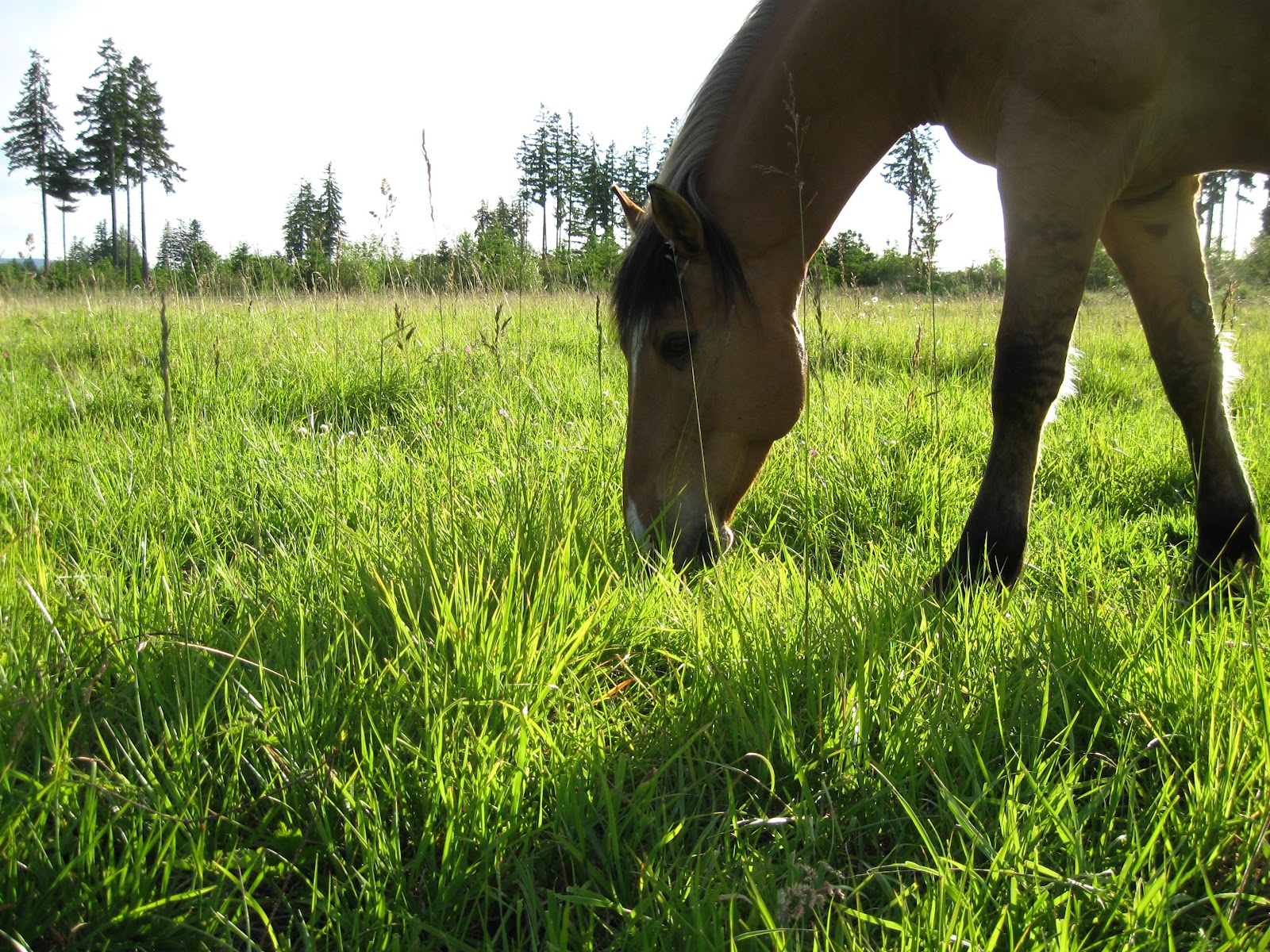
In addition to bringing my daughter for the first time, I was also able to bring Twister, a beautiful Mustang gelding who belongs to my friend at the stables. I have been working with Twister, riding him more and trying to find my seat on his back while adapting to his movement, which is so different from Chanty. He has long, slow strides that cover a lot of ground. He has a well conformed body with a strong back and powerful movement. And, without batting a horsey eyelash, he traveled two hours to a completely strange place and with barely a swish of his tail in protest or anxiousness, he adapted to new surroundings on the first night. While several horses were struggling with physical ailments or the anxiety of being separated from their barn mate during riding sessions, Twister took it all in stride. He has the horse personality that we all desire and which was bred into many of the working horses of the cowboy era. He can get the job done and not stress the owner/rider with any unexpected behavior. He is the "poster child" for gentle, natural horsemanship training. But he wasn't always quiet and tolerant. He had to work through the pressures of living with humans. He's been asked to put up with varying amounts of struggle with his owner and other people who've handled him. But, struggle can be a good thing because if we only experience things that are easy, we never discover how to deal with the more difficult aspects of life. This is true of horse AND human!

Just before I left for the clinic, I received a copy of Mark Rashid's new book, Nature in Horsemanship-Discovering Harmony through Principles of Aikido. I've always enjoyed reading Mark's books because he tells the story of his real life experiences from the time he was a young boy working with "the old man", right up to the present day. His current book is filled with stories of his time spent training to be a black belt in Aikido while continuing his life's work doing horsemanship clinics around the world. When owners bring their horses to him with problems, he is able to offer them sound advice based on the understanding he has about horse behavior. One chapter in particular peaked my interest: the use of pressure with horses.
It just so happened that in addition to Centered Riding instruction at the clinic at Barb's, she offered participants a chance to work on exercises done at liberty, using techniques she had recently learned at a Robin Gates clinic. Robin is a certified trainer in the Carolyn Resnick method of liberty training, based on Carolyn's book, Naked Liberty and her videos Panadero's Journey and Part 2: The Seven Waterhole Rituals. During the morning sessions, Barb would explain how to use treats to shape the behavior of the horse as you "share territory" with them. Using a tangible reward, like a treat or scratch, speeds up this shaping behavior and creates a connection between horse and human. When a horse begins to acknowledge the human as the source of the reward, it is possible to take the horse through more complex behaviors.
It occurred to me that I had been shaping the behavior of my horses and the horses I work with through a more recognizable method of training. I will put pressure on the horse, usually in the form of movement until the horse acknowledges me-in which case I would immediately release the pressure and allow the horse to stop moving. In this way, the horse looks to the human for the reward-release of pressure. But, what I've found out recently with my horse Image is that I must take her through varying stages of pressure-sometimes more extreme than I'm used to and then step back to evaluate the effect it has had on her over all. She came to me with what I see as a total lack of confidence due to her inexperience with the daily demands of a domestic horse. She may have been treated very kindly, but in keeping her isolated from the pressures of horse/human existence, she is unable to handle the stress that comes with any change in her environment or the demands put on her by her owner-me!
As Mark points out, horses in nature know just how much pressure to use and when to release it. They are masters at conserving energy and must practice this skill from an early age. This allows them to handle difficult situations and acquire the necessary skills to become emotionally, mentally and physically fit throughout their life. But, we as humans place them in confined spaces with limited mobility, sometimes never taking them out of their 'stable environment', always careful not to upset them or ask them to do anything that might put stress on them emotionally, mentally or physically.
Pressure is a natural part of life and is a necessary part of life with horses. Learning to use just enough pressure is a matter of experience. We must practice it with many horses, if possible. We owe it to our horses to not fear the use of pressure, even if means overdoing it once in a while. It will benefit the horse and human and give them the skills necessary to find harmony and to allow both to travel outside their "comfort zone" to greater awareness. It gives us the experience we need to handle the stress of daily life. It makes for a happy horse and owner. As Helen Keller once said, "Character cannot be developed in ease and quiet. Only through experience of trial and suffering can the soul be strengthened, ambition inspired and success achieved."
WATCH A VIDEO OF TWISTER AT HIS FIRST CENTERED RIDING/COMBO CLINIC
http://www.youtube.com/watch?v=P16ek8jZRuo
In addition to bringing my daughter for the first time, I was also able to bring Twister, a beautiful Mustang gelding who belongs to my friend at the stables. I have been working with Twister, riding him more and trying to find my seat on his back while adapting to his movement, which is so different from Chanty. He has long, slow strides that cover a lot of ground. He has a well conformed body with a strong back and powerful movement. And, without batting a horsey eyelash, he traveled two hours to a completely strange place and with barely a swish of his tail in protest or anxiousness, he adapted to new surroundings on the first night. While several horses were struggling with physical ailments or the anxiety of being separated from their barn mate during riding sessions, Twister took it all in stride. He has the horse personality that we all desire and which was bred into many of the working horses of the cowboy era. He can get the job done and not stress the owner/rider with any unexpected behavior. He is the "poster child" for gentle, natural horsemanship training. But he wasn't always quiet and tolerant. He had to work through the pressures of living with humans. He's been asked to put up with varying amounts of struggle with his owner and other people who've handled him. But, struggle can be a good thing because if we only experience things that are easy, we never discover how to deal with the more difficult aspects of life. This is true of horse AND human!
Just before I left for the clinic, I received a copy of Mark Rashid's new book, Nature in Horsemanship-Discovering Harmony through Principles of Aikido. I've always enjoyed reading Mark's books because he tells the story of his real life experiences from the time he was a young boy working with "the old man", right up to the present day. His current book is filled with stories of his time spent training to be a black belt in Aikido while continuing his life's work doing horsemanship clinics around the world. When owners bring their horses to him with problems, he is able to offer them sound advice based on the understanding he has about horse behavior. One chapter in particular peaked my interest: the use of pressure with horses.
It just so happened that in addition to Centered Riding instruction at the clinic at Barb's, she offered participants a chance to work on exercises done at liberty, using techniques she had recently learned at a Robin Gates clinic. Robin is a certified trainer in the Carolyn Resnick method of liberty training, based on Carolyn's book, Naked Liberty and her videos Panadero's Journey and Part 2: The Seven Waterhole Rituals. During the morning sessions, Barb would explain how to use treats to shape the behavior of the horse as you "share territory" with them. Using a tangible reward, like a treat or scratch, speeds up this shaping behavior and creates a connection between horse and human. When a horse begins to acknowledge the human as the source of the reward, it is possible to take the horse through more complex behaviors.
It occurred to me that I had been shaping the behavior of my horses and the horses I work with through a more recognizable method of training. I will put pressure on the horse, usually in the form of movement until the horse acknowledges me-in which case I would immediately release the pressure and allow the horse to stop moving. In this way, the horse looks to the human for the reward-release of pressure. But, what I've found out recently with my horse Image is that I must take her through varying stages of pressure-sometimes more extreme than I'm used to and then step back to evaluate the effect it has had on her over all. She came to me with what I see as a total lack of confidence due to her inexperience with the daily demands of a domestic horse. She may have been treated very kindly, but in keeping her isolated from the pressures of horse/human existence, she is unable to handle the stress that comes with any change in her environment or the demands put on her by her owner-me!
As Mark points out, horses in nature know just how much pressure to use and when to release it. They are masters at conserving energy and must practice this skill from an early age. This allows them to handle difficult situations and acquire the necessary skills to become emotionally, mentally and physically fit throughout their life. But, we as humans place them in confined spaces with limited mobility, sometimes never taking them out of their 'stable environment', always careful not to upset them or ask them to do anything that might put stress on them emotionally, mentally or physically.
Pressure is a natural part of life and is a necessary part of life with horses. Learning to use just enough pressure is a matter of experience. We must practice it with many horses, if possible. We owe it to our horses to not fear the use of pressure, even if means overdoing it once in a while. It will benefit the horse and human and give them the skills necessary to find harmony and to allow both to travel outside their "comfort zone" to greater awareness. It gives us the experience we need to handle the stress of daily life. It makes for a happy horse and owner. As Helen Keller once said, "Character cannot be developed in ease and quiet. Only through experience of trial and suffering can the soul be strengthened, ambition inspired and success achieved."
WATCH A VIDEO OF TWISTER AT HIS FIRST CENTERED RIDING/COMBO CLINIC
http://www.youtube.com/watch?v=P16ek8jZRuo
Friday, May 25, 2012
Mean to Your Horse
A couple of weeks ago I was mounting up and heading out to ride Chanty over at the river. The weather was gorgeous and it was my favorite time of day, just after 5 o 'clock. One of the other horse owners saw me throw my foot over her back and step into the stirrups and said "You're mean!". I knew what he meant and said, "you mean because I'm riding her again" and he said "yes." I had just finished an afternoon of riding lessons, using Chanty for two of the three sessions. She has so much patience with the students and has lately been helping them understand just how little contact with the bit it takes to slow and stop a horse. The students have been working on using their center and the scoop at the end of the engagement of their psoas. In addition, I've been encouraging riders to avoid bracing in their feet and ankles by lifting their knees slightly. The less pull that comes from hands and forearms, the less resistance and subsequent push from the horses front end students will feel. It's more comfortable for the horse and less effort for riders. We are also working at opening up the front of the upper body through the joints at the collarbone where they connect at the breast bone or sternum. Riders can feel their arms moving back where they hang naturally from their shoulders with elbow bent, creating a buttress that is much stronger than any direct pull on the reins. This is being kind to your horse and using correct aids to cue your horse.
Taking Chanty on a casual ride and continually exposing her to many different experiences has given her the ability to think more instead of react, remaining calm even when I take her to a completely new environment, as I did last Sunday, when I took her to my riding lesson with Karen in Tumwater. Because Chanty has gone to the park, the fairgrounds, to clinics, horse shows, ridden in pastures and arenas alike, she is a calm, confident horse who can cope with many different situations. This is the beauty of the nature of the horse-they are very adaptive and can learn to live with humans. In taking her on so many adventures, I've created a calm, confident, happy horse who trusts me in many different situations. Does that sound mean to you?
To me, being "mean" to a horse is expecting them to react differently than what nature tells them or using the same techniques to work with a horse, even though they are causing distress and resistance in the horse, putting you and/or the horse in danger of injury, and expecting a different response. Being mean isn't just inflicting physical pain on a horse, as has been used frequently, in a recently highly publicized practice of "soring" Tennessee Walkers. Being mean can be subtle and is usually the result of not understanding the horse's nature. Horses are very perceptive animals, especially to changes in their environment. It is what has kept them alive for millions of years. When you begin to expose a horse to various stimulus in their environment that initially frightens them, they will react or overreact, depending on their personality. Humans who find this behavior unacceptable because it may seem extreme or unwarranted for the situation-"oh just deal with it, will you", tend to become frustrated and use heavy handed measures to stop the behavior. While it's never acceptable for a horse to run over the top of you or push into you, the time to train a horse to move away from you and keep a safe distance, is not when horse and owner are squeezing into a tight space, in which a scary object sits just to the left of the horse's shoulder as the owner walks at the right shoulder. Of course an insecure, flightly horse will run into you or try to charge passed you-fear is what dictates the behavior. The time to deal with this fear is in a controlled environment in which the horse can learn to accept narrow spaces while on the end of a lead rope, with owner place safely at a distance, directing the horse's feet until he slows and follows the lead of his very calm, confident owner.
I've noticed recently that hormones in my two mares can change a calm, confident horse into a more reactive, less thinking horse. It is more of a challenge to continue working with a horse who last week took everything in stride and yet this week finds the mere thought of being asked to step sideways in an aisle way as a threat to their existence. The same techniques used to give the horse confidence are appropriate and especially important when the behavior seems over the top. It's human to try and deal with horse behavior with a direct response-unacceptable behavior means bad horse, means time to punish the horse. My friend who saw me leave on Chanty at the end of the long day would not find that "mean", but considers it just punishment for a misbehaving horse. I have caught myself recently falling into the old habit of blaming the horse for reacting or overreacting to what to us humans seems like a harmless situation. Sometimes we see ourselves doing it and know it is wrong for the situation and still, we can't help ourselves. Thank goodness the horse is so forgiving because, although it doesn't happen as often as it used to, I know it will happen again-it's OUR NATURE and in order to change, we too will have to adapt, so we can live with the horse.
Taking Chanty on a casual ride and continually exposing her to many different experiences has given her the ability to think more instead of react, remaining calm even when I take her to a completely new environment, as I did last Sunday, when I took her to my riding lesson with Karen in Tumwater. Because Chanty has gone to the park, the fairgrounds, to clinics, horse shows, ridden in pastures and arenas alike, she is a calm, confident horse who can cope with many different situations. This is the beauty of the nature of the horse-they are very adaptive and can learn to live with humans. In taking her on so many adventures, I've created a calm, confident, happy horse who trusts me in many different situations. Does that sound mean to you?
To me, being "mean" to a horse is expecting them to react differently than what nature tells them or using the same techniques to work with a horse, even though they are causing distress and resistance in the horse, putting you and/or the horse in danger of injury, and expecting a different response. Being mean isn't just inflicting physical pain on a horse, as has been used frequently, in a recently highly publicized practice of "soring" Tennessee Walkers. Being mean can be subtle and is usually the result of not understanding the horse's nature. Horses are very perceptive animals, especially to changes in their environment. It is what has kept them alive for millions of years. When you begin to expose a horse to various stimulus in their environment that initially frightens them, they will react or overreact, depending on their personality. Humans who find this behavior unacceptable because it may seem extreme or unwarranted for the situation-"oh just deal with it, will you", tend to become frustrated and use heavy handed measures to stop the behavior. While it's never acceptable for a horse to run over the top of you or push into you, the time to train a horse to move away from you and keep a safe distance, is not when horse and owner are squeezing into a tight space, in which a scary object sits just to the left of the horse's shoulder as the owner walks at the right shoulder. Of course an insecure, flightly horse will run into you or try to charge passed you-fear is what dictates the behavior. The time to deal with this fear is in a controlled environment in which the horse can learn to accept narrow spaces while on the end of a lead rope, with owner place safely at a distance, directing the horse's feet until he slows and follows the lead of his very calm, confident owner.
I've noticed recently that hormones in my two mares can change a calm, confident horse into a more reactive, less thinking horse. It is more of a challenge to continue working with a horse who last week took everything in stride and yet this week finds the mere thought of being asked to step sideways in an aisle way as a threat to their existence. The same techniques used to give the horse confidence are appropriate and especially important when the behavior seems over the top. It's human to try and deal with horse behavior with a direct response-unacceptable behavior means bad horse, means time to punish the horse. My friend who saw me leave on Chanty at the end of the long day would not find that "mean", but considers it just punishment for a misbehaving horse. I have caught myself recently falling into the old habit of blaming the horse for reacting or overreacting to what to us humans seems like a harmless situation. Sometimes we see ourselves doing it and know it is wrong for the situation and still, we can't help ourselves. Thank goodness the horse is so forgiving because, although it doesn't happen as often as it used to, I know it will happen again-it's OUR NATURE and in order to change, we too will have to adapt, so we can live with the horse.
Sunday, May 6, 2012
Plans for Spring
Spring is now showing it's beautifully sun soaked head. There was apparently a 'super moon' last night, but to me any moon is super if the sky is clear enough to see it. Spring means that we can let the horses out of their stalls more and that grazing muzzles will be coming out of mothballs for my easy keepers who gorge themselves on spring grass before their little guts are used to the high calorie meal.
And it means it's time to hit the road with Chanty for some riding lessons, trail rides and Centered Riding clinics here in Washington state, through May and June. Then in July, I'm planning a road trip to Chase, British Columbia to see French classical rider and master dressage clinician, Philippe Karl. I've watched his 4 DVD riding series over and over through the years as my knowledge has expanded. I can now say that when I listen to him explain lateral exercises, I truly understand how they work, why they're important and how to actually execute them correctly, if not perfectly. Then in August I am planning to go to a clinic with Robin Gates who trained with Carolyn Resnick on the "Seven Waterhole Rituals" and who does all of her work at liberty. It is still one of my favorite activities-work at liberty-not only with my students but with my own horses. I have recently been working with Image at liberty, including waterhole ritual 6 and 7, called "companion walking (magnetic connection)" and "come up and go, trot". They are the most difficult because your horse has to feel comfortable moving with you at close range as their energy and therefore their excitement level increases. This can worry some horses, while others feel imposed upon to move. Either way, they are very apt to turn and leave you. Image has responded beautifully by trotting close to my shoulder on a circle and then when heading straight down the arena will come with me until I lean back to signal an upcoming stop and back up. Beautiful! A real show of confidence and trust in my leadership. She is a bright energetic and engaging horse.
I was able to spend a few days watching a new instructor's clinic recently with my favorite Level 4 CR instructor, Karen, and decided I would take in every bit of information that she was offering so that I could apply it to my now expanding body of students. I remembered how proud I was three years ago, as I completed the new instructor clinic and was handed my certification and it was a great pleasure to meet a new group of bright, enthusiastic and energetic women willing to bring Sally Swift's teachings to a future generation of riders.
Thanks to Karen, my new favorite question to ask students is "What did you discover?" after each session of practicing new concepts in riding. It gives students a chance to recall what they were thinking while they rode and how their awareness was enhanced each time they allowed themselves to "find it, feel it, let it go." It's so easy to throw huge amounts of information at students as they ride past, thinking that as an instructor, you need to share everything you know with them in less than 30 minutes. Instead it makes more sense to "teach with a spoon, not a shovel."
The wisdom that comes with experience is not unique to riding instructors and not everything you learn from your instructor has to be about riding. Advice about taking care of yourself and listening to your body could apply to everyday living. Riding, like many things in life, is a collaborative effort and involves interacting with others. With continued practice and actively engaging in all aspects of your life you will become your "best self". Horses teach us to leave our weekly planners behind, live in the moment and enjoy the time spent in the warm sunshine of spring. That is my plan and I'm sticking to it. Enjoy your horse this spring.
And it means it's time to hit the road with Chanty for some riding lessons, trail rides and Centered Riding clinics here in Washington state, through May and June. Then in July, I'm planning a road trip to Chase, British Columbia to see French classical rider and master dressage clinician, Philippe Karl. I've watched his 4 DVD riding series over and over through the years as my knowledge has expanded. I can now say that when I listen to him explain lateral exercises, I truly understand how they work, why they're important and how to actually execute them correctly, if not perfectly. Then in August I am planning to go to a clinic with Robin Gates who trained with Carolyn Resnick on the "Seven Waterhole Rituals" and who does all of her work at liberty. It is still one of my favorite activities-work at liberty-not only with my students but with my own horses. I have recently been working with Image at liberty, including waterhole ritual 6 and 7, called "companion walking (magnetic connection)" and "come up and go, trot". They are the most difficult because your horse has to feel comfortable moving with you at close range as their energy and therefore their excitement level increases. This can worry some horses, while others feel imposed upon to move. Either way, they are very apt to turn and leave you. Image has responded beautifully by trotting close to my shoulder on a circle and then when heading straight down the arena will come with me until I lean back to signal an upcoming stop and back up. Beautiful! A real show of confidence and trust in my leadership. She is a bright energetic and engaging horse.
I was able to spend a few days watching a new instructor's clinic recently with my favorite Level 4 CR instructor, Karen, and decided I would take in every bit of information that she was offering so that I could apply it to my now expanding body of students. I remembered how proud I was three years ago, as I completed the new instructor clinic and was handed my certification and it was a great pleasure to meet a new group of bright, enthusiastic and energetic women willing to bring Sally Swift's teachings to a future generation of riders.
Thanks to Karen, my new favorite question to ask students is "What did you discover?" after each session of practicing new concepts in riding. It gives students a chance to recall what they were thinking while they rode and how their awareness was enhanced each time they allowed themselves to "find it, feel it, let it go." It's so easy to throw huge amounts of information at students as they ride past, thinking that as an instructor, you need to share everything you know with them in less than 30 minutes. Instead it makes more sense to "teach with a spoon, not a shovel."
The wisdom that comes with experience is not unique to riding instructors and not everything you learn from your instructor has to be about riding. Advice about taking care of yourself and listening to your body could apply to everyday living. Riding, like many things in life, is a collaborative effort and involves interacting with others. With continued practice and actively engaging in all aspects of your life you will become your "best self". Horses teach us to leave our weekly planners behind, live in the moment and enjoy the time spent in the warm sunshine of spring. That is my plan and I'm sticking to it. Enjoy your horse this spring.
Friday, February 24, 2012
Wanted: More Horses to Teach Humans
Wow! It is almost the end of February! Since Christmas came and went, the new year has been filled with wonderful experiences with the horses and my schedule has consistently been filled with equine activities. I've added many new students and I am really enjoying sharing the concepts of Centered Riding with everyone. In addition, I've been incorporating more of the teachings of Tom Nagel's "Zen and Horseback Riding". And there's a wonderful DVD, "Riding with Chi" that incorporates the amazing concepts of Tai Chi with centered, balanced posture and breathing. My students are taking in the information like sponges and it is so rewarding to see them pick up on the idea so quickly of riding with their breath.
With so many students coming out to ride, Chanty is getting a real work out. She is such a good teacher. She mirrors the students exactly and I can see when there is brace in their body or they are holding their breath. When she heads trotting into the center towards me and a chance to stop altogether, I know there is some serious tension going on in the rider. What's even better, is when the student finds their balance and posture, engages their center and is able to breathe out and relieve the tension in their body, I'll see Chanty walk off with relaxed head, staying out on the wall, enjoying the change in her rider.
I'm slowly working towards enlisting more "teachers" into my lessons. After six months with Image, I have noticed a real change in her movement and the way she carries herself. It's as if she has finally been reintroduced to her body. She knows where her feet are and her muscles carry her around efficiently. She has control over her movement and is comfortable going forward. In the past she seemed to move hesitantly, scurrying off without any organization in her movement. When she would lose her balance or step incorrectly, she would become upset and run in all directions to escape the discomfort. She would avoid areas of the arena that she knew were uneven and would make her feel even more imbalanced. Her physical inabilities effected her emotions and the cycle would repeat itself when I would ask her to change direction or step over an obstacle.
The change is amazing. Her confidence has grown as her body has developed more strength, balance and flexibility. She canters around the arena without hesitancy, she is less worried when I ask her to back or move away. She is not swishing her tail constantly and her eye has softened more and more. She is a wonderful animal and it warms my heart to see her blossom into a happy horse, full of energy. We are still working on letting her hoof wall grow out so that the separation and the cracks will turn into solid, sturdy walls that will carry her further and further. I plan to begin riding her this spring and take her so many places. AND...give Chanty a break.
With so many students coming out to ride, Chanty is getting a real work out. She is such a good teacher. She mirrors the students exactly and I can see when there is brace in their body or they are holding their breath. When she heads trotting into the center towards me and a chance to stop altogether, I know there is some serious tension going on in the rider. What's even better, is when the student finds their balance and posture, engages their center and is able to breathe out and relieve the tension in their body, I'll see Chanty walk off with relaxed head, staying out on the wall, enjoying the change in her rider.
I'm slowly working towards enlisting more "teachers" into my lessons. After six months with Image, I have noticed a real change in her movement and the way she carries herself. It's as if she has finally been reintroduced to her body. She knows where her feet are and her muscles carry her around efficiently. She has control over her movement and is comfortable going forward. In the past she seemed to move hesitantly, scurrying off without any organization in her movement. When she would lose her balance or step incorrectly, she would become upset and run in all directions to escape the discomfort. She would avoid areas of the arena that she knew were uneven and would make her feel even more imbalanced. Her physical inabilities effected her emotions and the cycle would repeat itself when I would ask her to change direction or step over an obstacle.
The change is amazing. Her confidence has grown as her body has developed more strength, balance and flexibility. She canters around the arena without hesitancy, she is less worried when I ask her to back or move away. She is not swishing her tail constantly and her eye has softened more and more. She is a wonderful animal and it warms my heart to see her blossom into a happy horse, full of energy. We are still working on letting her hoof wall grow out so that the separation and the cracks will turn into solid, sturdy walls that will carry her further and further. I plan to begin riding her this spring and take her so many places. AND...give Chanty a break.
Tuesday, December 27, 2011
The Christmas Gift
It's been two days since we all sat excitedly in front of the Christmas tree sharing the joy of gift giving. My shopping was done weeks ago and my list was simple. Mostly I wanted a new video camera, so I could record my students and the horses as they progress in their journey and enhance their relationship with each other. I am hoping to record their lessons and create a personal DVD that they can watch over and over. It's a great way to learn through visual information. I'm best when I can first see, then do, followed by hear then do and lastly, read, then do. The visual medium is a great tool for me, both as a teacher and a student. I knew I would be using the camera constantly and was so happy to see it under the tree on Christmas day.
But, I must say, my favorite gift this year was a short ride across the street from the stables to the Columbia River park known as Willow Grove. The weather was warm and mild, just under 60 degrees on Christmas Eve. The sun was shining and dropping lower as I began riding in late afternoon. I knew it would be the last day for a while that I would have both the time and the good weather to ride. As I write this, the rain is coming down in buckets, the wind churning as it rings the chimes just outside my window.
The river was calm and the park almost deserted, everyone undoubtedly running around, anxious to put the finishing touches on their Christmas celebrations. I couldn't believe how fortunate I was, how far I had come in my horsemanship and riding. Each time I take Chanty to the park alone, I marvel at how far we've come. She walks slowly down the driveway, crosses the road and up the sandy path that leads to a flat stretch of grass that overlooks the park and is the first view of the river. It's gorgeous and I can now appreciate it fully because I am not focused on slowing my horse. We walk together, our movements in sync. My lower back flexes, my hip,knee and ankle joints gently opening and closing. My contact with the bit in Chanty's mouth is minimal and easily goes forward and back as she vibrates her breath softly across her lips. It is the sound of contentment and I now see the calm confident horse in her that I had dreamed of 6 years ago when I first brought her to this park, kicking and screaming. Back then, she ran in fear and I pulled hard on her mouth, convinced she was misbehaving and needed only to be overpowered by me, gripping and grabbing, bracing every muscle in my body, draped across her back, like the predator I was.
As recently as this past month, I have begun incorporating more focused movement of the lower back, the lumbosacral joint into my riding and emphasizing it during my lessons with students. It is the bridge between the alternating hip movement of the lower body with hips, knees and ankles flexing and the absorption of movement up the spine of the back, through the shoulders and arms, rippling into the neck and upper spine as it connects to the head at "the poll" just between the ears. The spine connects to the pelvis with a joint that allows for forward and back as well as side to side movement. It has not always been emphasized in the descriptions of centered riding or even in my recent studies of the psoas OR it was assumed that this joint was the source of "engagement" of the deep centering muscles of the psoas. In any case, the more I focus on and make myself aware of that body part, the more my conscious competence in using the joint has grown. I am almost at the point at which I can ride without picturing my lower back during a transition or turn, the most important time to keep the movement free and flowing. Not only is the ride easier and smoother for both of us, there is no pain from straining outside muscles previously used to unnecessarily brace and balance on Chanty-no pain for me OR her.
We walked, we cantered and we returned to the stables with the same calm, confident attitude that carried us out just an hour earlier. Now as I returned from our ride, I stepped out of the saddle, hugged Chanty and genuinely showered her with affection and appreciation-no pulling, no racing, no harsh words.
She has given me so many things over the years, but this year I was given a Christmas gift that I will not soon forget. It really is all about the relationship with the horse, creating harmonious movement between two living creatures and it gets better and better every year. I can't wait for the New Year to see what treasures are waiting for me with the horses in my life.
Saturday, October 29, 2011
Zen for Riders-Another Milestone
Part I: Do You Really Know What Good Posture Is?
WOW! I finally got a chance to go to a Rider's Seat Combo Clinic with Tom Nagel and Karen Irland this week. Ever since I've become a CR Instructor, I've been hearing about Tom's course and the "missing link" to riding through the correct use of the psoas (pronounced so az) muscle. Tom actually calls it the First Key to Centered Riding, followed by the four basics, techniques and visualizations of Sally Swift's groundbreaking first book .
Sally actually uses the word psoas and shows the anatomy in her 2nd edition book but working with Tom, you are able to isolate the part of your body that represents the true CORE-the place of stability that so many of the best riders can access without thinking (see unconscious competence in previous blog).
Somewhere along the line, we develop habits that force our body to work harder, with tense, tight and often sore outside muscles. I've been told in the past that the key to a stronger back is to develp strong tight "6 pack abs". Turns out, according to Tom, that when you engage your core and the muscles of the psoas, you can create stability in you body that makes it easier to use the abdominals and all the other muscles of movement. With simple tone in those muscles, the psoas takes them along for the ride as you physically move through your day or participate in physical activity, including riding. So why the emphasis on six pack abs? Because you can see them and it represents achievement in physical strength. BUT DO WE REALLY NEED THEM TO BE THAT LARGE? Maybe if you're a competitive body builder. But for the average human, it's more about correct use of your body from the inside out. This was very revealing to me. It explains another comment in Sally's book, that says it is not about physical strength but correct use of self that makes riding so harmonious with your horse. So how do you use your self correctly and what does the psoas have to do with it?
It starts with posture, what those in the know call an independent seat. We have all become dependent on the chair we sit in and when you ride that way it creates an imbalance that not only upsets your horse, but forces you to tense and tighten your outside muscles to avoid falling over. The psoas, deep in the body, connects the upper body to the lower and when you adjust the lower back and pelvis by flexing this muscle, you actually LENGTHEN your lower back and level your pelvis-but you must let those six pack abs soften. With a simple exhale, release of the solar plexus and what Tom calls the scoop motion of bringing your pelvis up, you have created a stable center from which all else will emerge. The top part of the psoas is the core that stabilizes and the bottom part connects to hip flexors. And here was a real surprise for me once I practiced Tom's exercises. When you release the tension in your outside muscles, engage your core, it actually releases the tension all the way to the top of the head-all of a sudden I was moving my head at the top of my spine right where the vertebral column connects to the skull, my "pole" if you will. Now I have stability and my upper body feels longer and more mobile. I have LIFT.
This just gets better and better. But why should you believe me? To quote Mr. Nagel "If it's stable, it works." Try using your six pack abs next time you try to stay on your horse as he spooks at a leaf blowing in his path. You can show the doctor in the emergency room how buff you are as they're wheeling you to the xray department to count how many ribs are cracked on your left chest. Stability in your core and tone in your outside muscles (strength with flexibility) creates ease of movement. Now you're in self carriage (how many times have we heard that term without really knowing what it meant?) To ride in harmony our movement must be vertical and alternate from side to side as our 4 legged horizontal horse moves us forward. It works so much easier once you release the tension and develop simple tone in your outside muscles as you put your psoas to work. At the top of the body are the hyoid (pronounced hi oid) muscles that engage up to level the chin and release the shoulders. It is the scoop at the top of the body.
Having good posture used to mean sit up straight, don't slouch and while it appears from the outside that you are using your body correctly, we now know that a good posture in riding and in life means tone, self carriage with stability that allows freedom of movement, free from pain caused by tension and locked joints. As Karen would say, "How cool is that?"
NEXT: Part II Breathing or "Did You Know Your Horse is a Martial Artist"?
WOW! I finally got a chance to go to a Rider's Seat Combo Clinic with Tom Nagel and Karen Irland this week. Ever since I've become a CR Instructor, I've been hearing about Tom's course and the "missing link" to riding through the correct use of the psoas (pronounced so az) muscle. Tom actually calls it the First Key to Centered Riding, followed by the four basics, techniques and visualizations of Sally Swift's groundbreaking first book .
Sally actually uses the word psoas and shows the anatomy in her 2nd edition book but working with Tom, you are able to isolate the part of your body that represents the true CORE-the place of stability that so many of the best riders can access without thinking (see unconscious competence in previous blog).
Somewhere along the line, we develop habits that force our body to work harder, with tense, tight and often sore outside muscles. I've been told in the past that the key to a stronger back is to develp strong tight "6 pack abs". Turns out, according to Tom, that when you engage your core and the muscles of the psoas, you can create stability in you body that makes it easier to use the abdominals and all the other muscles of movement. With simple tone in those muscles, the psoas takes them along for the ride as you physically move through your day or participate in physical activity, including riding. So why the emphasis on six pack abs? Because you can see them and it represents achievement in physical strength. BUT DO WE REALLY NEED THEM TO BE THAT LARGE? Maybe if you're a competitive body builder. But for the average human, it's more about correct use of your body from the inside out. This was very revealing to me. It explains another comment in Sally's book, that says it is not about physical strength but correct use of self that makes riding so harmonious with your horse. So how do you use your self correctly and what does the psoas have to do with it?
It starts with posture, what those in the know call an independent seat. We have all become dependent on the chair we sit in and when you ride that way it creates an imbalance that not only upsets your horse, but forces you to tense and tighten your outside muscles to avoid falling over. The psoas, deep in the body, connects the upper body to the lower and when you adjust the lower back and pelvis by flexing this muscle, you actually LENGTHEN your lower back and level your pelvis-but you must let those six pack abs soften. With a simple exhale, release of the solar plexus and what Tom calls the scoop motion of bringing your pelvis up, you have created a stable center from which all else will emerge. The top part of the psoas is the core that stabilizes and the bottom part connects to hip flexors. And here was a real surprise for me once I practiced Tom's exercises. When you release the tension in your outside muscles, engage your core, it actually releases the tension all the way to the top of the head-all of a sudden I was moving my head at the top of my spine right where the vertebral column connects to the skull, my "pole" if you will. Now I have stability and my upper body feels longer and more mobile. I have LIFT.
This just gets better and better. But why should you believe me? To quote Mr. Nagel "If it's stable, it works." Try using your six pack abs next time you try to stay on your horse as he spooks at a leaf blowing in his path. You can show the doctor in the emergency room how buff you are as they're wheeling you to the xray department to count how many ribs are cracked on your left chest. Stability in your core and tone in your outside muscles (strength with flexibility) creates ease of movement. Now you're in self carriage (how many times have we heard that term without really knowing what it meant?) To ride in harmony our movement must be vertical and alternate from side to side as our 4 legged horizontal horse moves us forward. It works so much easier once you release the tension and develop simple tone in your outside muscles as you put your psoas to work. At the top of the body are the hyoid (pronounced hi oid) muscles that engage up to level the chin and release the shoulders. It is the scoop at the top of the body.
Having good posture used to mean sit up straight, don't slouch and while it appears from the outside that you are using your body correctly, we now know that a good posture in riding and in life means tone, self carriage with stability that allows freedom of movement, free from pain caused by tension and locked joints. As Karen would say, "How cool is that?"
NEXT: Part II Breathing or "Did You Know Your Horse is a Martial Artist"?
Subscribe to:
Posts (Atom)