
In addition to my ongoing work in Centered Riding, I've actually begun to take on more horses who need training from the ground up. Let me rephrase that. I've actually begun to take on more horse OWNERS who need training from the ground up. After years of trying to figure out a way to explain the reasoning behind all of the "Revolution in Natural Horsemanship" methods, I think I've finally begun to piece it together so that it makes sense to me and so have begun to share this with other horse lovers.
I feel strongly that teaching people about horse behavior and relationships in the herd has to be done with lots of colorful and meaningful associations to human behavior. No, horses are not human, but no one can deny, that the reason so many people love horses and want to be around them for long periods of time is that they reveal so much to us about our own struggles with confidence and trust and patience. We choose to be with a very large imposing animal, who could potentially harm us, and yet, if we tap into their world for even 20 minutes and make a connection, we feel as if we've discovered the meaning of life. I search and search for better ways to explain how, after 25 years, I've been able to tap into this world for brief moments-some of the most pleasant and rewarding times of my life.
And so, as I say, there's one thing that seems to help humans learn quickly and retain information more than anything else (Read the book "Moonwalking with Einstein" for more details): create some type of association with vivid visual images set in familiar locations , filled with colorful details and lots of humor; a story, if you will, that you will NEVER forget. In the book I mentioned above, the author gives a grocery list of 6 items to remember. In addition to the list, there is an incredibly colorful detailed image of people and situations that are simply unforgettable. Two months later I can still list them.
This story starts from the beginning: When a foal is born, she has the physical characteristics inheritied from her parents. Hair color, eye color, size and shape of her head and eyes, legs and feet-everything. Including her personality. Horses typically have either a shy, reserve, potentially more fearful personality OR they have an assertive, sometimes more pushy or dominant personality. These traits can be very obvious to an outside observer or they can be very subtle. The idea of horses having personalities is not new. The well known Parelli "Horsenalities" video and printed material has lots of details about what distinguishes one from another. But what I've discovered is that the way we approach them is easier to remember if we think of how they were treated as babies.
When a horse is still a baby, the mare allows the individual personality traits to express themselves without much restraint-not pushing the shy/fearful horse too far away or overeacting to the naturally sensitive youngster. Nor does she try to dampen the spirit of the willful and sometimes overconfident dominant horse. She creates safety and security and begins the process by which horses learn to follow a confident leader
A leader-a horse or human who does not become confrontational with the dominant horse, chasing her off or forcing her to constantly defend herself. She does not scare the shy horse by driving her away with no chance to find relief from the ensuing anxiety and/or physical exhaustion. A leader asks for something (usually movement) and gives immediate release of pressure when the horse she chooses to lead, gives the correct response. A good leader knows just how much pressure to put on a horse based on their individual personality. She watches for the reaction she gets and adapts her behavior accordingly.
Not every horse needs to be run in circles to get them to respect the leader. Shy, fearful, reactive horses actually find it incredibly stressful emotionally to be run off and may continue to run and run in a circle or confined area until they appear as if they've checked out mentally.
Ah, but the mother mare cannot continue to "look the other way" when it comes to her baby's behavior. Once the foal becomes large enough to interact safely with the herd, she begins to put limits on how much pushing and shoving and kicking, bucking, leaning her baby is allowed to do. Humans understand this and know that they cannot allow their kids to be out of control after a certain age, clinging and crying and kicking and screaming to get their way. And so, the mare uses direct or driving pressure to move her youngster away from her. For the dominant pushy youngster, this may mean a few kicks and pushes and bites from mom or even being driven forcefully out of the herd until the youngster understands that mom is in charge of her movement and is the only one who can allow her back in to the safety and comfort of the herd. The young one then learns to "ask" to return, keeping a respectful distance as well as a constant eye on the leader when she looks at her, just in case she makes another request. This develops respect and confidence in the leader. If this is not a part of the horse human relationship, the dominant horse will begin to assert itself with physical defensive moves. This can be as small as waving the head and neck to push a human away or as big as biting and kicking when the horse percieves any kind of confrontation.
For the shy, reticent, reactive youngster, mom simply walks away from the foal, creating more distance, only using very slight direct or driving pressure to increase the distance when the foal returns uninvited. The mare understands that for the foal to gain confidence, the separation cannot be done severely or rapidly, but eventually the youngster will need to be on her own, able to interact with other members of the herd as well as new sights and sounds. Like sending them to day care or kindergarten to learn to "play well with others." The shy horse who does not learn to trust humans and see them as leaders, will not adapt to new situations easily, may run in fear if overtly reactive or may freeze and explode when pushed too far. We have all met kids and adults who appear calm on the outside, but when under pressure have done things that seemed out of character-a young man who is very smart and calm, but when put behind the wheel during driver's ed cannot figure out which way to turn at a four way stoplight when in the right lane.
Now that I can explain these behaviors based on the relationship horses have with their moms, it makes sense to my students. Of course, most of them are women who have been moms or have been around kids enough. Heck, they understand because they've been kids before. And I tell them Horses were Babies Once Too.....
Part 2: Now That They Know You're a GOOD Leader!
Thursday, April 28, 2011


Friday, February 11, 2011
A Serious Skin Infection
I am fortunate that my "real job" in the world is working in the health care field in primary care, where I see every kind of health problem including staph infections. In recent history, there have been cases in which people have died from "flesh eating bacteria" in which the infection spread quickly through the deeper layers of tissue. This was usually a strep bacteria, but in the last few years, there have been more cases of staph infections, specifically staph infections resistant to a strong antibiotic called methicillin (the so called "MRSA" infections). Staph lives on the skin of humans as well as horses and for the most part causes no problems or possibly minor infections, including the common childhood skin disease, impetigo, in which yellow crusty lesions are found on the skin. But in horses or human with a compromised immune system, the staph infection can rage out of control quickly. Older horses typically have a harder time fighting off disease and so are especially susceptible. Almost 30 yrs old, my mare Rose falls into that category. She could have gotten it from me, as I had recently had small skin lesions that resembled staph, on my hand. They had been from scratches I'd received when trimming, and had healed up quickly with simple hand washing.
It started as a small bump on her face and neck as well as significant swelling in both front lower legs. I thought Rose had just been standing in her stall too long and had some ankle edema and fluid retention. But, when I ran my hand down her legs, I felt more bumps and when I rubbed on the hair, it fell away, revealing significant open wounds on her skin. Because they were linear I thought she had scratched herself. I washed them with warm water and didn't think much of it. By the next day both of her legs were swollen, with open red hot lesions, weaping with yellow serous drainage. The lesions on her head were larger as well. These were not scratches-this was the beginning of a serious staph infection. It may have started with a small break in the skin (humans always come to me, sure that they have a "spider bite"), but it was quickly becoming a widespread outbreak.
Fortunately, I had seen many staph infections in my professional life and knew that the treatment for it was a sulfa antibiotic. And, I just happened to have a 7 day course of the antibiotic in my posession, having kept it from the time when Rose had injured herself on a barb wire fence. Instead of using the sulfa, I sprayed the Vetricyn CF that my vet had given me, with fantastic healing results. I still had some of the spray left and after scrubbing her legs with hibiclens (an antiseptic wash) I sprayed the Vetricyn up and down her front legs. Rose had already been taking daily butte for her shoulder arthritis, so she was not acting pained at all.
Here's photos of her legs in the first days of the infection. Notice the swelling at her knees.


I was able to keep the infection under control by jumping on it quickly and Rose was more than happy to eat the applesauce laced feed that I mixed the powdered meds in. Fortunately, she was never uncomfortable and accept for not being able to go out with her buddy Chanty (staph infections are very contagious), she was perfectly happy and bright throughout the 7 day treatment. I was careful to wear disposable latex gloves to handle her legs and when I scrubbed her. I used a hand sanitizer after working with her and before going in to take care of my other horses.
It's now been about 10 days since I began treating Rose and I continue to spray the Vetricyn on her legs every day. This is the concentrated formula, which can be purchased only from a vet, stronger than the spray you can buy at a pet store. It is specifically for wound healing and on the bottle indicates it is effective against MRSA. The skin is drying up and now looks like this:

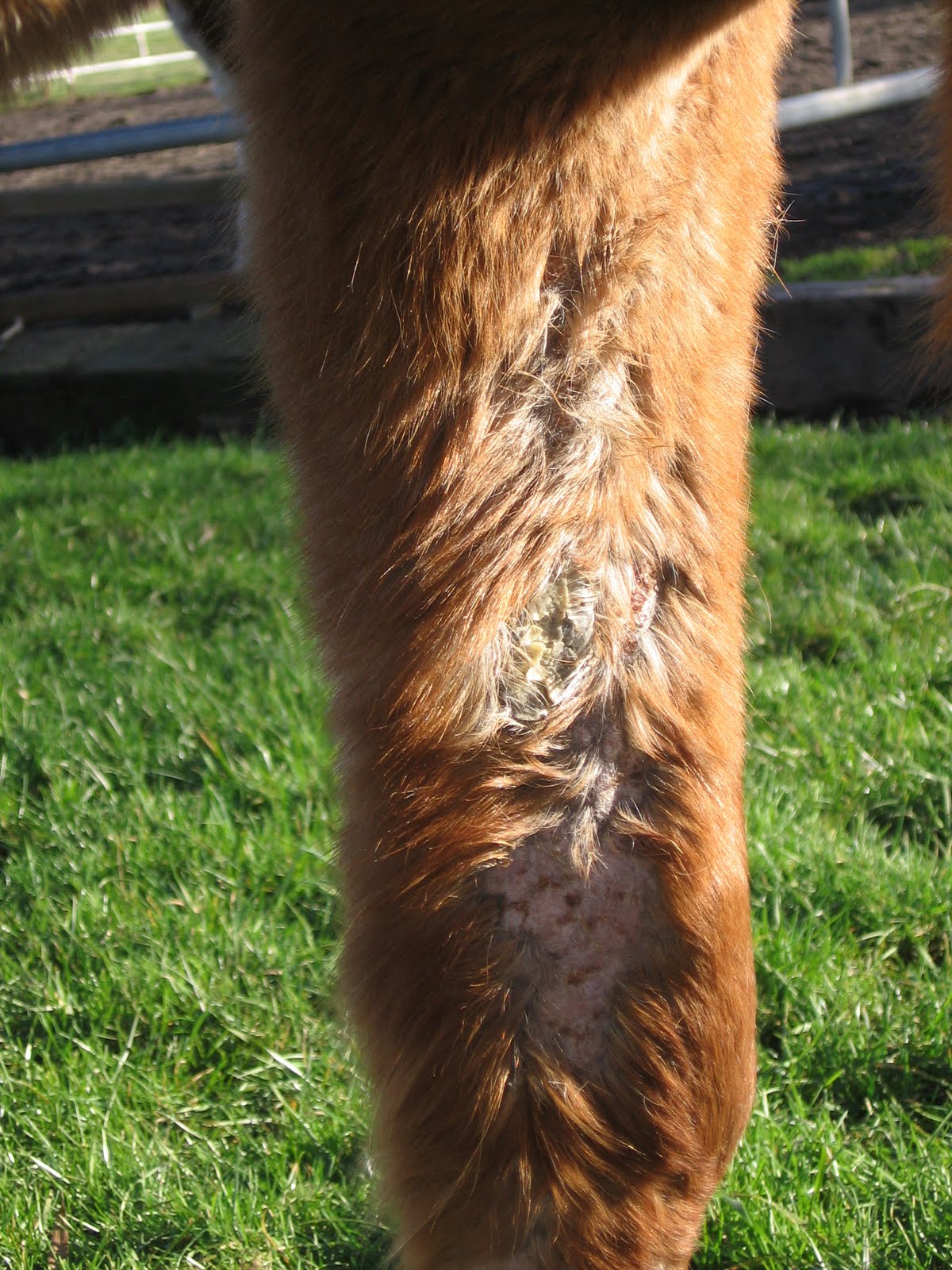
 What could have potentially been a deadly infection has turned out to be a controlled skin condition that I'm hoping will heal up as fast as it broke out. Rose is going to be moving to my best friend's place nearby for her 2nd and final retirement. All attempts to ride her have been futile, as her shoulder arthritis is very debilitating for her if she tries to do more than a trot and especially with a rider on her back. Ironically, her feet have done wonderfully with the trim and she no longer stands with her weight forward due to painful heels. Her toe walking now is from the stiffness in her shoulders from years of walking incorrectly.
 Rose continues to teach me about the horse and especially the senior horse. They are very sensitive to illness and injury and we must always be on the alert for any changes in their health. I think she'll enjoy her new home and will hopefully get to spend time again with Sally, my other aging girl. My dermatologic (skin) challenge with her has been seborrhea dandruff but I'll leave that story and photos for my next blog.
Thursday, November 11, 2010
Rosie's New Pasture Mate
When Rose first moved to her new home at the stables near the Columbia River, she was given a pasture mate who unlike her previous stablemate was much younger-almost 20 yrs younger. Chester, a 12 year old palomino quarter horse was lame when I met him. The diagnosis-navicular disease. His owner had spent the previous six years trying everything to improve his gait and relieve the pain in his left foot. It had been agonizing for both horse and owner and had finally led to a surgical procedure to remove a piece of calcified bone that had grown off of the navicular bone. After complete stall rest for months and shoes to protect his heels, Chester was no better and his owner had resolved herself to keeping Chester as a "pasture pet", perfect to keep 'ol Rose company.


 It's now November and Chester has begun going out with younger geldings like himself. He has been running around the arena with his owner at full speed, changing direction, trotting with his head held high and no signs of pain. He is no longer on any med for pain or inflammation and his owner plans to saddle him up for the first time in years. He is a fit 12 yr old whose life could have been cut short by a completely preventable condition. I hope his days of running and playing are all in front of him and that more horses get a second chance, thanks to the wonderful teachings of Pete Ramey and persistent owners like myself who want to help the horse who depends on us entirely for his care. Chester's owner told me that she would share her experience with barefoot trimming with his previous caregivers so that they may learn another method of caring for horses who in the past were considered lame and hopeless.
I had begun revising my trimming technique with Rose and putting her boots on more regularly, when I began talking with Chester's owner. I explained that I had begun trimming my own horses after I became disillusioned with traditional veterinary and farrier management of founder and navicular. I had learned that Rose's navicular condition had begun when she was put into shoes at an early age, before her heels had a chance to grow into tough, well developed cartilage deep inside, covered by a wide, healthy frog, necessary in every horse in order to tolerate the physical demands of an active 1000 lb animal. Each year as Rose ran around in shoes, her heels took the full impact of her weight, without really being able to absorb that impact. She then began walking on her toes to avoid the pain. Soon after, pads were put between her foot and shoes. That worked for a short time, but eventually Rose would begin walking up on her toes, and finally would shift her entire body forward to avoid a heel first landing.
In addition to putting shoes on horses at a early age and inhibiting the normal development of the thickened tough cartilage called the digital cushion, horse's can become lame and avoid contact with their heels if the frog is constantly being shaved off with trimming, or if the sole is thinned to put a shoe on, bringing the coffin bone closer to the ground and the angle of the heel going the opposite direction. This can lead to contraction of the heel and lack of stimulation to the internal structures, mainly the digital cushion. With the steep angle of the foot, the natural deep flexion of the tendon at the back of the foot becomes shortened and the joint space narrows as the navicular bone rubs against the adjacent bone and nerve. Pain becomes inevitable and the horse avoids walking on the heel more and more. Shoulder pain follows as the horse's gait shortens and becomes tense and stiff. As the bones rub against each other, a "spur" develops that is simply calcified bone created from chronic inflammatory damage, followed by attempts by the body to repair the bone.
When Chester finally went in for surgery, a piece of bone was removed that was 1/2 to 3/4 inches in length. Now almost 18mos after surgery when we met and still in shoes, he was in pain and being given daily bute or some subsitute for it. I explained the process by which navicular syndrome occurs and offered to trim Chester in what became "the last resort" for his owner. I told her that his shoes would have to come off and we would be using boots with pads on him to help with the transition-this would be a must! She agreed and a week later I began trimming Chester. This was July, just 3 mos ago. His left foot looked like this when I began:

The tip of the coffin bone was pointing down with the bulge of the hoof wall at the toe, a sure sign that the bone had moved forward in the capsule. In addition, evidenced by the shallowness of the collateral grooves at the apex of the frog, his sole was less than an 1/8th of an inch thick

and the coffin bone was JUST UNDERNEATH IT. His heels were contracted, very common in horse's with long standing pain in their heels or shoes that create a narrow width to the foot, depending on which comes first. The most important part of rehabilitating navicular syndrome is to encourge heel first landings-lots of them. Chester was put out with Rose and allow to move around on soft ground for hours, grazing. When brought in to exercise, he wore hoof boots with pads for his heels. In this way he can put the full weight of his body into a heel first landing, encourage stimulation of his inner structures, digital cushion as well as lateral cartilages, so important in side to side movements. Chester was really hard on boots, having ripped offf the gaiters on two different boots, so it was a good thing that his barefoot walking in the pasture was working to stimulate his foot. By September, there was a definite improvement in his ability to take heel first landings without pain. The structure of his foot was changing and his coffin bone while still close to the ground (no concavity of the foot yet) was beginning to level out to a ground parallel (or close to it) angle.
 It's now November and Chester has begun going out with younger geldings like himself. He has been running around the arena with his owner at full speed, changing direction, trotting with his head held high and no signs of pain. He is no longer on any med for pain or inflammation and his owner plans to saddle him up for the first time in years. He is a fit 12 yr old whose life could have been cut short by a completely preventable condition. I hope his days of running and playing are all in front of him and that more horses get a second chance, thanks to the wonderful teachings of Pete Ramey and persistent owners like myself who want to help the horse who depends on us entirely for his care. Chester's owner told me that she would share her experience with barefoot trimming with his previous caregivers so that they may learn another method of caring for horses who in the past were considered lame and hopeless.
More good things to come I'm sure!!!!!!
Tuesday, October 19, 2010
I've Discovered "Feel"-Riding Gets Better and Better
An amazing breakthrough in my riding has occured. I think I've finally discovered "feel". It is something that I recognize in other activities but in my day to day riding, it has escaped me. I actually began practicing it while driving in my truck recently, hauling Chanty to a clinic four hours from home.
I was apprehensive about travelling so far with her in the trailer, especially through the very congested highways around Seattle. I knew I would have to leave at an early hour to miss rush hour in the big city. I prepared for the trip by making sure my truck and trailer had recently been maintained and that I had a spare tire for the trailer, as well as a way to change it, if necessary. The only issue that remained was how to keep myself from focusing so intently on the drive, the traffic, the other cars,as well as worry about how Chanty was doing in the back of the trailer. The weather cooperated nicely and for the most part, it is a straight shot down the highway. In order to quiet some of my fears, I listened to an audio CD that I keep in my truck. It is Jane Savoie's series on "The Rider's Edge" about techniques each of us can use to overcome fear and negative thinking. It can be applied to any aspect of our lives and can best be summed up as "what your brain thinks, your body feels."
So when I drove down the highway and began thinking, "is Chanty okay back there, is she hurting or nervous from the noise or the bouncing? Am I going to hit heavy traffic and have to change lanes quickly and what if I don't stop in time? what if someone cuts in front of me and I have to slam on the brakes? am I driving slow enough? what's that in the road? how fast am I going?" And on and on and on....
With all that overanalyzing going on, it is no wonder my palms were sweating and my heart was racing and my stomach was in knots. Too much information! I've been driving for 37 years and I've hauled my horse in a trailer for over 5 yrs. Sure this was the longest we've gone and sure there was going to be traffic, but as long as I allowed my abilities as a driver to take over and just feel for changes in the traffic, or the speed of the cars in front of me, I would just naturally adjust to those changes. Stop overloading the system. When you let your instincts take over, it's a sure sign othat you've gained experience from years of practice. It's like putting the car on cruise control or auto pilot. I wasn't asleep at the wheel. I was still very aware of what I needed to do at a moment's notice. But, now I could take it all in as a blending of sights and sounds, all creating one experience.
And that is exactly what I did today when I rode. I was circling Chanty at the canter to the right through cones. When I wanted to make the circle large, I would pass the cone at about 20 feet to the left of it. Then I would spiral down closer to the cone in the center and back out, all the while keeping the circle round and a consistent rhythm and speed to her canter. Instead of analyzing my position, my hands, my weight in the stirrups and every other detail of the movement, I just let my experience take charge. I'd practiced this so many times before and now my body was free of tension. It made it so much easier to just think about what I wanted and let it happen. I could make small adjustments if I needed to, but if I found myself trying to analyze and fix too much, the beautiful feeling would go away. And with it, our harmonious movement. I rode pain free and found I was able to remember how it felt so that I can practice another technique that many successful people use-visualization. I can recreate my rides and "feel" the entire experience, in the comfort of my recliner at home. Then when I take that with me in the saddle, I can have my brain think it and my body will feel it. WOW this just gets better and better.
I was apprehensive about travelling so far with her in the trailer, especially through the very congested highways around Seattle. I knew I would have to leave at an early hour to miss rush hour in the big city. I prepared for the trip by making sure my truck and trailer had recently been maintained and that I had a spare tire for the trailer, as well as a way to change it, if necessary. The only issue that remained was how to keep myself from focusing so intently on the drive, the traffic, the other cars,as well as worry about how Chanty was doing in the back of the trailer. The weather cooperated nicely and for the most part, it is a straight shot down the highway. In order to quiet some of my fears, I listened to an audio CD that I keep in my truck. It is Jane Savoie's series on "The Rider's Edge" about techniques each of us can use to overcome fear and negative thinking. It can be applied to any aspect of our lives and can best be summed up as "what your brain thinks, your body feels."
So when I drove down the highway and began thinking, "is Chanty okay back there, is she hurting or nervous from the noise or the bouncing? Am I going to hit heavy traffic and have to change lanes quickly and what if I don't stop in time? what if someone cuts in front of me and I have to slam on the brakes? am I driving slow enough? what's that in the road? how fast am I going?" And on and on and on....
With all that overanalyzing going on, it is no wonder my palms were sweating and my heart was racing and my stomach was in knots. Too much information! I've been driving for 37 years and I've hauled my horse in a trailer for over 5 yrs. Sure this was the longest we've gone and sure there was going to be traffic, but as long as I allowed my abilities as a driver to take over and just feel for changes in the traffic, or the speed of the cars in front of me, I would just naturally adjust to those changes. Stop overloading the system. When you let your instincts take over, it's a sure sign othat you've gained experience from years of practice. It's like putting the car on cruise control or auto pilot. I wasn't asleep at the wheel. I was still very aware of what I needed to do at a moment's notice. But, now I could take it all in as a blending of sights and sounds, all creating one experience.
And that is exactly what I did today when I rode. I was circling Chanty at the canter to the right through cones. When I wanted to make the circle large, I would pass the cone at about 20 feet to the left of it. Then I would spiral down closer to the cone in the center and back out, all the while keeping the circle round and a consistent rhythm and speed to her canter. Instead of analyzing my position, my hands, my weight in the stirrups and every other detail of the movement, I just let my experience take charge. I'd practiced this so many times before and now my body was free of tension. It made it so much easier to just think about what I wanted and let it happen. I could make small adjustments if I needed to, but if I found myself trying to analyze and fix too much, the beautiful feeling would go away. And with it, our harmonious movement. I rode pain free and found I was able to remember how it felt so that I can practice another technique that many successful people use-visualization. I can recreate my rides and "feel" the entire experience, in the comfort of my recliner at home. Then when I take that with me in the saddle, I can have my brain think it and my body will feel it. WOW this just gets better and better.
Sunday, October 17, 2010
Teacher as Student
I'm back from another Centered Riding Clinic. This time it was for instructors who wished to update their CR certification. It's now been more than a year since I met the first of many enthusiastic and energetic people who embrace the teachings of the now legendary Sally Swift. Since last September, I've been able to use my new found skills to enhance my own riding and horsemanship as well as share the information with my students. At this clinic, I was reminded that the foundation of Centered Riding are the four basics, Soft Eyes, Breathing, Building Blocks (Balance) and Centering that works best when we are Grounded. I know I've been using those basics with my teaching but, now I understand them even more and will incorporate them in my daily activities, not just my equine experiences. The clinic, held at the amazing Rhodes River Ranch, was a chance to meet even more people, like myself, who believe in the power of education and the transforming properties of the Centered Riding philosophy when using it in their riding and instruction.
Every time I attend a CR Clinic, I become a student again. I find that it is eye opening in so many ways. As a health professional, I have had a chance on a few occcasions to experience what it feels like to be a patient. The vulnerability, the insecurity, the fear and the uncertainty can be overwhelming. Allowing someone else to dictate the direction of my life for even a short time is not a comfortable feeling for me. When you are the patient, you must let someone else tell you what needs to be done. There is tension and apprehension-our personality dictates how much we "allow" without question. I am usually an active participant in my care because I understand what is going on and the information is not as foreign to me, as it would be to a lay person. What always stays with me after my experience as a patient, though, is the feelings I had for the providers who cared for me. It starts from the moment I meet him or her.
Did the provider engage in conversation with me from the beginning and make me feel as if they were listening or did they immediately dive into what's wrong and what needs to be done? Were they empathetic? Did they answer my questions? Did they try to allay my fears, make me feel more confident in them and in my ability to actively participate in my health care problems, as well as recovery? Did they communicate in a way that made sense to me? Was it an overall positive experience, even if the process involved emotional and or physical stress (sometimes pain is part of the experience)? If the answer is yes to all of these questions, chances are, I will not hesitate to return to that provider when I need care in the future.
The same is true, when I become a student rider of a CR instructor or clinician. It begins with a sense of vulnerability and uncertainty and if a positive connection is not made from the beginning, it can quickly dissolve into a tense experience, physically and emotionally, and an uncomfortable feeling for both horse and rider. This leads to lack of confidence, which creates further tension, until the rider is no longer able to concentrate on their own abilities.
I had just such an experience years ago with an instructor. We had never met and she introduced herself to me. She asked my horse's name only after she expressed several opinions: 1) my horse was too small for me 2) My saddle did not fit me or my horse 3) she did not like the word I used to express my new found experience of balancing myself with seat bones contacting the saddle correctly. 4) She disagreed with a particular method of visualizing a certain muscle in the body to center ourselves, stating that there were more than JUST one and it was incorrect to give credit to that particular muscle. 5) Contradicted me immediately when I explained that the word "allow" when used in riding, to me was not a direction that translated to an active motion in the body.
As you can imagine, I felt immediately deflated emotionally. I loved my horse and had been riding for years. Our relationship had grown and flourished and she had taught me as much, if not more than any instructor I've had in my life. My saddle issues had been ongoing, but I felt I was working with what I had in the best way possible. While I am a long tall person, my horse was certainly not a pony and had the stout, muscular features capable of carrying me without stress or strain. I had been excited and encouraged by the progress I had made with my seat and my balance through a method of releasing tension in one group of muscles of my body, while allowing others to activate. It had improved my balance and centering, further advancing my riding abilities. Being a very procedural person, I liked direction that gave me something I could "do", even if in the process, something passive was happening that made the whole thing work well together. I did understand the process of "allowing" things to happen and go with the feel.
I heard what the instructor said and I knew what she meant, but somehow, the delivery of her words, created emotions in me that translated into uncertainty. With each movement, I questioned my ability, over analyzing my technique and eventually regressed to the beginning rider of my early years. My shoulders dropped, my head rotated when I turned, my weight tipped forward, my feet were no longer evenly weighted in the saddle and my breathing was non existent. I was a mess! How did this happen so quickly?
The first moments of our experience with a new teacher, instructor, doctor, boss, customer service representative, or ANYONE that we look to for help or information, are critical. It's not about them, it's about US. We need to feel confident in their abilities, knowing that they are there for us, listening to our words, understanding our needs, able to communicate with us in a way that makes sense.
As an instructor I am now learning what it means to be grounded emotionally, before I begin a lesson. I will take a deep breath, clear my mind, check in with my own body and release any tension, aware of my surroundings prior to involving my student or her horse. I try to remember to stay balanced when I stand, to use my body correctly and avoid stress on my joints, that creates tension throughout my body, making it more difficult to focus on my student. I give my student a chance to do the same and avoid putting pressure on them to do something in the first 10-15 minutes. Watching them interact with their horse tells me a lot about how their feeling and what the relationship is like at that moment.
It is a wonderful experience to be a teacher. Being able to incorporate my love of horses with my passion for teaching means that I will continue to grow as a person and an equestrian from this moment on. But, I must always remember what it means to be a student. If I have that thought in mind, every time I begin a lesson, I will never fail to create an environment that will promote learning as well as fun for every student. ENJOY THE RIDE!
Every time I attend a CR Clinic, I become a student again. I find that it is eye opening in so many ways. As a health professional, I have had a chance on a few occcasions to experience what it feels like to be a patient. The vulnerability, the insecurity, the fear and the uncertainty can be overwhelming. Allowing someone else to dictate the direction of my life for even a short time is not a comfortable feeling for me. When you are the patient, you must let someone else tell you what needs to be done. There is tension and apprehension-our personality dictates how much we "allow" without question. I am usually an active participant in my care because I understand what is going on and the information is not as foreign to me, as it would be to a lay person. What always stays with me after my experience as a patient, though, is the feelings I had for the providers who cared for me. It starts from the moment I meet him or her.
Did the provider engage in conversation with me from the beginning and make me feel as if they were listening or did they immediately dive into what's wrong and what needs to be done? Were they empathetic? Did they answer my questions? Did they try to allay my fears, make me feel more confident in them and in my ability to actively participate in my health care problems, as well as recovery? Did they communicate in a way that made sense to me? Was it an overall positive experience, even if the process involved emotional and or physical stress (sometimes pain is part of the experience)? If the answer is yes to all of these questions, chances are, I will not hesitate to return to that provider when I need care in the future.
The same is true, when I become a student rider of a CR instructor or clinician. It begins with a sense of vulnerability and uncertainty and if a positive connection is not made from the beginning, it can quickly dissolve into a tense experience, physically and emotionally, and an uncomfortable feeling for both horse and rider. This leads to lack of confidence, which creates further tension, until the rider is no longer able to concentrate on their own abilities.
I had just such an experience years ago with an instructor. We had never met and she introduced herself to me. She asked my horse's name only after she expressed several opinions: 1) my horse was too small for me 2) My saddle did not fit me or my horse 3) she did not like the word I used to express my new found experience of balancing myself with seat bones contacting the saddle correctly. 4) She disagreed with a particular method of visualizing a certain muscle in the body to center ourselves, stating that there were more than JUST one and it was incorrect to give credit to that particular muscle. 5) Contradicted me immediately when I explained that the word "allow" when used in riding, to me was not a direction that translated to an active motion in the body.
As you can imagine, I felt immediately deflated emotionally. I loved my horse and had been riding for years. Our relationship had grown and flourished and she had taught me as much, if not more than any instructor I've had in my life. My saddle issues had been ongoing, but I felt I was working with what I had in the best way possible. While I am a long tall person, my horse was certainly not a pony and had the stout, muscular features capable of carrying me without stress or strain. I had been excited and encouraged by the progress I had made with my seat and my balance through a method of releasing tension in one group of muscles of my body, while allowing others to activate. It had improved my balance and centering, further advancing my riding abilities. Being a very procedural person, I liked direction that gave me something I could "do", even if in the process, something passive was happening that made the whole thing work well together. I did understand the process of "allowing" things to happen and go with the feel.
I heard what the instructor said and I knew what she meant, but somehow, the delivery of her words, created emotions in me that translated into uncertainty. With each movement, I questioned my ability, over analyzing my technique and eventually regressed to the beginning rider of my early years. My shoulders dropped, my head rotated when I turned, my weight tipped forward, my feet were no longer evenly weighted in the saddle and my breathing was non existent. I was a mess! How did this happen so quickly?
The first moments of our experience with a new teacher, instructor, doctor, boss, customer service representative, or ANYONE that we look to for help or information, are critical. It's not about them, it's about US. We need to feel confident in their abilities, knowing that they are there for us, listening to our words, understanding our needs, able to communicate with us in a way that makes sense.
As an instructor I am now learning what it means to be grounded emotionally, before I begin a lesson. I will take a deep breath, clear my mind, check in with my own body and release any tension, aware of my surroundings prior to involving my student or her horse. I try to remember to stay balanced when I stand, to use my body correctly and avoid stress on my joints, that creates tension throughout my body, making it more difficult to focus on my student. I give my student a chance to do the same and avoid putting pressure on them to do something in the first 10-15 minutes. Watching them interact with their horse tells me a lot about how their feeling and what the relationship is like at that moment.
It is a wonderful experience to be a teacher. Being able to incorporate my love of horses with my passion for teaching means that I will continue to grow as a person and an equestrian from this moment on. But, I must always remember what it means to be a student. If I have that thought in mind, every time I begin a lesson, I will never fail to create an environment that will promote learning as well as fun for every student. ENJOY THE RIDE!
Saturday, August 21, 2010
Out of Retirement

It's been a very busy summer. Since returning from the clinic in Yelm in June, a lot of changes have occured. The first one has been a monumental one for my first horse, 29 year old Rose, who for the last seven years has been retired out to pasture, spending most of her time with Tetley, who is more than 30 yrs old. While I was out of town Rose was given two new pasture mates, one of whom was given to the owner to ride, the other, just visiting while his pasture was being sprayed for weeds. Initially, the young geldings were separated from the old folks by a temporary fence, made partially from old barb wire. Rose, being the beauty that she is, immediately attracted the two young geldings' attention. Unfortunately, Rose was more than willing to back herself up to the fence, raise her tail and "show off" her stuff. When the geldings tried to reach across the fence to connect with Rose, she kicked and caught her hind leg just inside the hock on the wire, tearing the flesh and creating a nasty open wound.
Initially, I was called to attend to Rose and to make daily visits to clean and dress the wound. But, after the visiting gelding left and the new resident gelding was allowed to mingle with Rose and Tetley, it was evident that the threesome was not going to work. The young guy constantly ran Tetley off and made Rose his own. Soon, she was calling me to take Rose out of the pasture and if possible find her a new home. After seven years, I wasn't sure where she could go and have the same freedom and daily movement she needed with the safety of a calm, experienced, docile pasture mate.
As fate would have it, I'd recently met a woman through my job whose mother owned the stables around the corner from my friend's barn. We'd talked and I immediately found her to be friendly and upbeat. When I tried to think of a place to bring Rose, it occured to me that the closest place, most convenient, would be at her stables. Luckily, when I called, she had not one but 3 stalls available! I moved Rose two days later after having the vet give her a "cocktail" of sedatives to make her ride in the trailer less traumatic. Rose has never liked riding in the trailer and with her injury, plus the stress of leaving her home and good buddy of 7 years,I thought it best to make her travel to her new home as comfortable as possible.
Just before we left, the vet took a look at her injury, now 4 weeks old and recommended a spray called Vetericyn VF (twice as potent as the over the counter version), used to help heal wounds. He had not heard of it before and said he was not sure if it would work, as the ingredients were simple saline and sodium phosphate and hypochlorous acid. It claims that it has an "oxychlorine compound" similar to what the animal's immune system produced. I was the first client to whom he was selling a bottle and he asked me to report on her progress. Well, within 1 week, the wound had reduced in size by one third and I didn't even cover it or bother to give her the sulfa oral powdered antibiotics he gave me. (I'm skeptical when the same antibiotic is given to horses for everything and would rather not expose them to it unless absolutely necessary). It's now been 2 mos and the wound is down to a dime size pink scrape, and like other horse wounds I've seen, seems to have created it's own structure with lines of demarcation filled in with new colored skin and hair. Nature is amazing.
Now that Rose is in a stall at a stable, she is on a daily schedule very similar to her retirement: out at 8 am with a pasture buddy (a young horse suffering from navicular syndrome, who after 6 yrs of failed treatment, including surgery and corrective shoeing, has become one of my trimming clients-more on that in another blog....). She comes in at 8 pm and in between has been enjoying the sunshine and the freedom of a two acre turnout.
The big change has been that,now that she is in my care, I have begun to exercise her on the ground and I noticed something interesting. While comfortable out in pasture on her bare feet, she cannot handle the pounding of heel first landings at trot and canter in the arena. It turns out, I had been trimming her feet to fit a horse standing still or standing on soft pasture. She really has not completely developed her heels and the inner structures sufficiently to be worked at more demanding gait or unforgiving surface. So....I am reworking my trim with her and re-evaluating my techniques. I've gone back and read over and over the article from Pete Ramey, "Heel Height, the Deciding Factor." and now it makes sense. Just because it says to keep the heel approximately 1/4 inch off the sole and give the coffin bone a ground parallel angle while standing still (or close to it), this does not work when we have a horse who's heels are mushy and underdeveloped. It just sends them up on their toes, wearing down the wall unevenly and slowing the whole process to a stop.
I'm now putting boots on Rose as much as possible and will be leaving her heels a little higher (maybe up to 1/2 inch) until she shows that she can walk, trot and canter on the ground she lives and works on (mainly arena or grass for now). It's exciting to see her move out more and I've actually saddled her up and walked her around. She is so smooth and so comfortable to ride on. I'm so thrilled and I hope she will enjoy the new activity as well. Maybe she hadn't planned to come out of retirement, but I know she has a lot of good years ahead of her. Maybe by helping young and old riders gain their confidence and find that balanced seat, as a lesson horse. You're never too old to get a new job. WELCOME BACK ROSIE!!!!
Here's a video of my daughter Laura riding Rose for the first time in seven years:
Initially, I was called to attend to Rose and to make daily visits to clean and dress the wound. But, after the visiting gelding left and the new resident gelding was allowed to mingle with Rose and Tetley, it was evident that the threesome was not going to work. The young guy constantly ran Tetley off and made Rose his own. Soon, she was calling me to take Rose out of the pasture and if possible find her a new home. After seven years, I wasn't sure where she could go and have the same freedom and daily movement she needed with the safety of a calm, experienced, docile pasture mate.
As fate would have it, I'd recently met a woman through my job whose mother owned the stables around the corner from my friend's barn. We'd talked and I immediately found her to be friendly and upbeat. When I tried to think of a place to bring Rose, it occured to me that the closest place, most convenient, would be at her stables. Luckily, when I called, she had not one but 3 stalls available! I moved Rose two days later after having the vet give her a "cocktail" of sedatives to make her ride in the trailer less traumatic. Rose has never liked riding in the trailer and with her injury, plus the stress of leaving her home and good buddy of 7 years,I thought it best to make her travel to her new home as comfortable as possible.
Just before we left, the vet took a look at her injury, now 4 weeks old and recommended a spray called Vetericyn VF (twice as potent as the over the counter version), used to help heal wounds. He had not heard of it before and said he was not sure if it would work, as the ingredients were simple saline and sodium phosphate and hypochlorous acid. It claims that it has an "oxychlorine compound" similar to what the animal's immune system produced. I was the first client to whom he was selling a bottle and he asked me to report on her progress. Well, within 1 week, the wound had reduced in size by one third and I didn't even cover it or bother to give her the sulfa oral powdered antibiotics he gave me. (I'm skeptical when the same antibiotic is given to horses for everything and would rather not expose them to it unless absolutely necessary). It's now been 2 mos and the wound is down to a dime size pink scrape, and like other horse wounds I've seen, seems to have created it's own structure with lines of demarcation filled in with new colored skin and hair. Nature is amazing.
Now that Rose is in a stall at a stable, she is on a daily schedule very similar to her retirement: out at 8 am with a pasture buddy (a young horse suffering from navicular syndrome, who after 6 yrs of failed treatment, including surgery and corrective shoeing, has become one of my trimming clients-more on that in another blog....). She comes in at 8 pm and in between has been enjoying the sunshine and the freedom of a two acre turnout.
The big change has been that,now that she is in my care, I have begun to exercise her on the ground and I noticed something interesting. While comfortable out in pasture on her bare feet, she cannot handle the pounding of heel first landings at trot and canter in the arena. It turns out, I had been trimming her feet to fit a horse standing still or standing on soft pasture. She really has not completely developed her heels and the inner structures sufficiently to be worked at more demanding gait or unforgiving surface. So....I am reworking my trim with her and re-evaluating my techniques. I've gone back and read over and over the article from Pete Ramey, "Heel Height, the Deciding Factor." and now it makes sense. Just because it says to keep the heel approximately 1/4 inch off the sole and give the coffin bone a ground parallel angle while standing still (or close to it), this does not work when we have a horse who's heels are mushy and underdeveloped. It just sends them up on their toes, wearing down the wall unevenly and slowing the whole process to a stop.
I'm now putting boots on Rose as much as possible and will be leaving her heels a little higher (maybe up to 1/2 inch) until she shows that she can walk, trot and canter on the ground she lives and works on (mainly arena or grass for now). It's exciting to see her move out more and I've actually saddled her up and walked her around. She is so smooth and so comfortable to ride on. I'm so thrilled and I hope she will enjoy the new activity as well. Maybe she hadn't planned to come out of retirement, but I know she has a lot of good years ahead of her. Maybe by helping young and old riders gain their confidence and find that balanced seat, as a lesson horse. You're never too old to get a new job. WELCOME BACK ROSIE!!!!
Here's a video of my daughter Laura riding Rose for the first time in seven years:
Tuesday, June 29, 2010
The Power Seat- "One Stop Shopping"

I don't know if you're old enough to remember the days when in order to get all of the items on your grocery list, you had to go to at least 3, if not 4 different stores. There was the butcher shop, where you bought your meat, a bakery for your bread and donuts, a produce stand where you would buy your fruits and vegetables and if you needed anything for your medicine cabinet, you had to go to the "drugstore". It was time consuming, inconvenient and frustrating if you'd forget something and have to make another trip across town.
Well, now there's a simple solution for shopping-the superstore or supermarket! And just as remarkable, is a simple straightforward way to find your POWER SEAT when you ride. By engaging the supportive, powerful CORE muscles (no, I mean the REAL core muscles) of the psoas, located deep inside the body, you'll be able to sit deep in the saddle, wrap your legs snugly around your horse's barrel and keep your feet exactly where they need to be: grounded with equal weight in the stirrups. You will breathe softly and maintain your balance, and your joints will flex and absorb the motion of your horse.
Thanks to the brilliant, yet simple explanation by Karen Irland, Level 4 Centered Riding Instructor and the genius of Tom Nagel's simple book, "Zen and Horseback Riding", (see previous blog entry, "It's Like Breathing Out and Breathing In") riding is even more fun than I imagined. Although, I had read the book prior to attending a recent CR clinic with Karen, her explanation of how to put it into action made it come to life. Now I can't believe how easy it is, not only to use it in my own riding, but to teach it to others, in MINUTES! You don't have to constantly adjust your body as individual parts. You know, just as you fix one, you have to think through another method for adjusting the others. Not anymore....
The most dramatic thing for me was realizing just how much I tighten my abdominal muscles when I ride which immediately pulls you on to the front of your pelvis or pubic bone, instead of on your seat bones . This in turn, limits the movement of your hips, inhibits breathing, creates brace in your lower leg and removes your inner thigh contact. You must soften the abdominals, even if you have to poke yourself with your fingers and breathe through your mouth to encourage the relaxation. It took several attempts to really feel it and keep the softness. Once the abdominals are soft you'll begin to feel yourself sitting in the saddle with knees flexed and lower legs wrapped around your horse's barrel.
Now comes the real key to it all: engaging your psoas. This big muscle on both sides of your spine connects just below the last rib at your back and stretches deep in the pelvis or bowl in your lower body (your bladder is at the bottom of the bowl) and then connects at the top of the big leg bone, called the femur just where we feel our thighs . With your abdominal muscles "mushy" you can lengthen your spine and the stretch the psoas down easily (think of bringing your belly button back towards your spine-you'll initially feel like your slumping-this is your pelvis rocking as you put more contact on the mid portion or seat bones). This immediately tones the inner thigh muscles which creates improved contact with the horse. With the psoas engaged, you are now sitting on your seat bones, instead of pubic. And with your abdominal muscles relaxed, you are able to breathe better and move your hips easily. 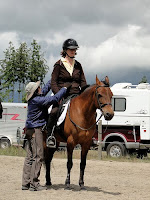
Karen was kind enough to remind me over and over, to soften my abdomen and engage my psoas. An additional benefit to allowing this to happen is that when the hips move easily, so do the feet. When you tighten and tip forward on your "pube" as she called it, you brace in the stirrups and bring your heels too far up or too far down, depending on which direction you tend to brace and with it, you lock your hips and knees. But, with the psoas engaged and joints all moving (hips, knees and ankles) it becomes very clear that these natural shock aborbers are more efficient.
The comfort we feel is reflected in our horses movement as well. Now you can feel the left and right, up and down movement of your horse's hips. Your lower legs, thighs toned and secure around your horse can make imperceptable movements to cue your horse and as you remain grounded in your stirrups, you can rise at the trot, allowing your knees, hips and ankles to absorb the motion. Transitions become a simple act of inhaling to warn your horse that something is about to happen and exhaling as you engage your psoas and complete the transition.
Soften abs, lengthen the spine, feel better contact with seat bones, tone the inner thighs for better contact, feel the freedom of movement of all the joints with feet grounded. You've achieved the POWER SEAT with just one simple act: engaging your psoas. It really is one stop shopping! Best of all, it's easy to share with my students and they can tell the difference immediately. Try it and ENJOY!
Subscribe to:
Posts (Atom)